By Dr. Vaishali Vilas Sonavane
Abstract
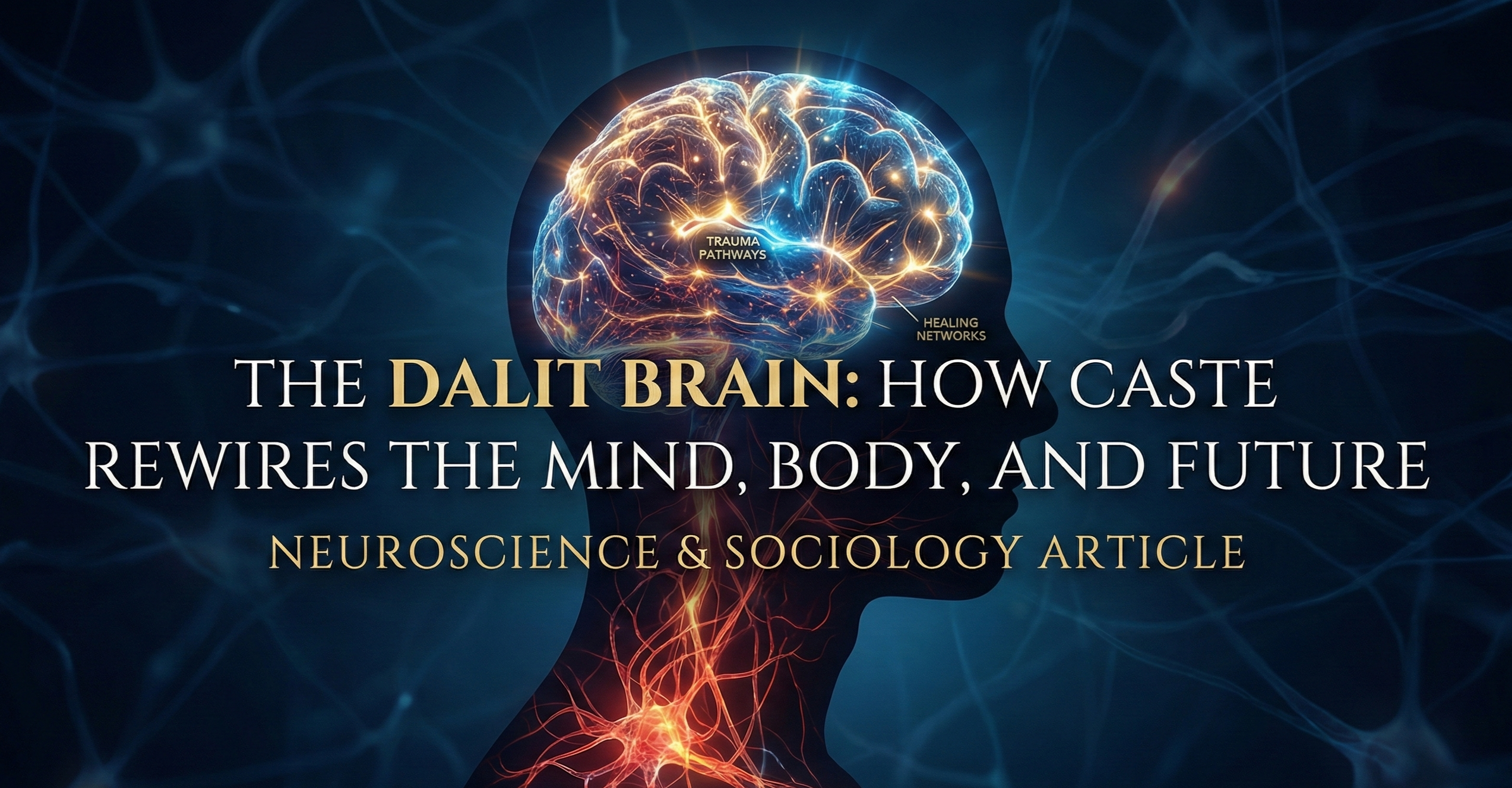
Caste is often framed as a social, cultural, or political system, but emerging neurobiological research reveals that long-term oppression fundamentally reshapes the human nervous system. For Dalits, centuries of humiliation, forced labor, threat of sexual violence, segregation, and caste terror have produced neurobiological adaptations that prioritize survival over safety.
Drawing from neuroscience, trauma theory, and epigenetics, this article analyzes how caste-based oppression affects brain structure, stress regulation, emotional processing, and intergenerational gene expression. The paper argues that caste is not only a social hierarchy—it is a biological imprint transmitted across generations through stress physiology and epigenetic markers.
The five-part analysis outlines- (1) the neurological impact of caste, (2) how humiliation registers as physical pain, (3) intergenerational trauma, (4) the phenomenon of “brain hijacking,” and (5) the need for nervous system healing as part of Dalit liberation. The article concludes that justice for Dalit communities must include policies and healing frameworks that address the neurobiological consequences of caste oppression.
Introduction
Caste in India is frequently discussed in sociological, political, and economic terms. Yet the human body is the first site where caste violence is recorded. The repetitive nature of caste discrimination produces physiological stress responses that, over time, reshape neural circuitry, stress hormone pathways, memory networks, and the autonomic nervous system (Arnsten, 2009; McEwen, 2017).
For Dalits, caste is not an abstract idea—it is a lived, sensory, hormonal, and neurological experience. Dalits frequently report body-based reactions in casteist environments- “My mind goes blank around dominant castes.” “My chest tightens before I speak. “I feel like my body leaves me when I’m humiliated.”
As Gabor Maté (2022) emphasizes, trauma is not defined by the external event but by the internal physiological response. In Dalit communities, trauma is continuous, normalized, and inherited.
This article integrates neuroscience, epigenetics, trauma psychology, and Dalit lived experience to explore how caste literally “gets under the skin.” Each section builds upon the previous to demonstrate how caste shapes not just life outcomes, but biological survival systems—and why healing must be central to Dalit liberation.
PART 1: How Caste Gets Under the Skin — The Neurology of Being Dalit
Caste does not merely organize society; it organizes the nervous system. Centuries of caste oppression—untouchability, humiliation, sexual violence, forced labor, acute poverty, and constant threat—activate the body’s stress response systems so persistently that they alter brain development (Arnsten, 2009; McEwen, 2017).
The Body Learns Caste Before the Mind Does-
Dalit children absorb caste rules through bodily cues- being told not to touch the water pot, standing outside classrooms, being served food last or separately, and learning to lower their gaze.
What begins as social exclusion becomes neurological conditioning-
Prolonged stress shrinks the prefrontal cortex, weakens emotional regulation, and heightens fear responses (Arnsten, 2009). This explains why many Dalits report blank minds during confrontation, shrinking voices in hierarchical settings, and intense vigilance in public spaces.
Neurobiology Confirms Lived Experience-
According to Huberman (2023), chronic stress reduces cognitive clarity and induces brain fog due to suppressed prefrontal function. Dalits often express this as, “My brain stops working when they question me.” “I forget everything in front of them.” These are not personality flaws—they are neurological adaptations to systemic danger.
Trauma Inside the Dalit Body-
Maté (2022) describes trauma as internal reactions to overwhelming adversity. For Dalits, this internal adversity includes hypervigilance, physiological collapse, chronic fear conditioning, emotional numbing, and automatic compliance. Dalit bodies have been wired for survival, not safety.
PART 2: Why Humiliation Hurts — The Neuroscience of Caste Rejection
Humiliation—daily, normalized, and institutionalized for Dalits—is not merely emotional pain. Neuroscience proves that social pain activates the same neural pathways as physical pain (Eisenberger & Lieberman, 2004; Eisenberger, 2015).
Caste Violence as a Form of Neural Injury-
When a Dalit child is told not to touch shared resources, when a Dalit woman’s dignity is violated as a warning to her community, When a Dalit man is stripped and beaten for asserting equality, when Dalit queer and transgender persons are forced into caste “limits,” The brain activates its pain circuitry as though the body is under physical assault.
The Dorsal Anterior Cingulate Cortex, The Brain’s Alarm Center –
This region lights up during rejection, humiliation, exclusion, and bullying. For Dalits, these assaults are routine, not rare. This explains physical symptoms such as a racing heartbeat, trembling hands, breathlessness, stomach knots, and chest pain.
Trauma Stored as Physiology-
Van der Kolk (2014) notes that trauma is stored in the body as chronic tension, shutdown, emotional numbing, and dissociation. Dalits carry not individual traumas but collective, embodied, historical trauma, woven into daily living.
PART 3: Inherited Fear — Epigenetics and the Intergenerational Trauma of Caste
Epigenetic research demonstrates that traumatic experiences alter gene expression, and these changes can be passed down across generations (Yehuda et al., 2016).
Caste Trauma Leaves Biological Marks-
Dalit families inherit heightened cortisol responses, hypersensitive stress systems, reduced prefrontal regulation, patterns of silence and vigilance, and fear-based behavioral conditioning. These patterns mirror findings from historically oppressed groups exposed to chronic violence (Patterson & Chetty, 2022; Sathyamala, 2021).
Dalit Children Do Not Begin with Blank Slates-
They are born into nervous systems shaped by ancestral terror, collective memory of humiliation, stories of punishment for agency, and inherited hypervigilance.
Lived Illustrations of Epigenetic Trauma-
- Dalit students are going blank during oral exams.
- Dalit employees avoid conflict even when harmed.
- Dalit women carrying vigilance around public spaces.
- Dalit men freezing during encounters with police.
These are not “weaknesses”—they are survival codes passed across generations.
PART 4: Brain Hijacking — Naming the Psychological Violence of Caste
“Brain hijacking” refers to the dominance of survival circuits over cognitive circuits (Sapolsky, 2015). For Dalits, this state is nearly constant because caste creates a perpetual threat.
Four Major Dalit Survival States-
- Freeze- When speaking or resisting invites punishment, the body immobilizes. “My voice disappears around dominant castes.”
- Fog- As Huberman (2023) explains, chronic stress impairs executive function. “I forget everything.” “My brain shuts down.”
- Fawn- Generations of enforced servitude produce automatic appeasement responses. This is not emotional weakness—it is survival intelligence.
- Hypervigilance- Constant threat sensitizes the amygdala (Clark et al., 2019). Dalits scan for danger in workplaces, classrooms, villages, and police encounters, and public spaces.
The Cost of Survival Mode-
Dalits use enormous cognitive resources to stay alive, leaving little for rest, dreaming, creativity, and planning long-term goals. Caste robs the brain of bandwidth.
PART 5: Toward Dalit Liberation — Healing the Nervous System and Dismantling Caste
Healing the Dalit nervous system is not optional—it is necessary for justice.
Caste Oppression Produces Measurable Health Impacts.
Research shows chronic discrimination leads to higher depression and anxiety rates, stress-related physical illness, and impaired immunity (Williams & Mohammed, 2009; Kaur & Sinha, 2021). These outcomes are biological consequences, not psychological failures.
Healing Must Be Both Political and Physiological.
Healing requires challenging ‘upper’ caste supremacy, building trauma-informed systems, reclaiming Dalit epistemologies, ensuring representation and safety, and restoring bodily dignity.
What Healing Looks Like in the Body-
- The body stops bracing for attack.
- The voice stops shrinking.
- The breath deepens.
- The nervous system trusts safety.
- The brain shifts from survival to possibility.
The Promise of a Future Beyond Fear
Liberation begins when Dalit bodies no longer carry centuries-old terror as biology. A liberated Dalit future is one where-
- Dignity is felt, not negotiated,
- Safety is embodied, not imagined,
- The nervous system is no longer hijacked by caste.
Healing the Dalit nervous system is not just personal—it is political, collective, and revolutionary.
References:
- Arnsten, A. F. T. (2009). Stress signalling pathways that impair prefrontal cortex structure and function. Nature Reviews Neuroscience, 10(6), 410–422. https://doi.org/10.1038/nrn2648
- Clark, U. S., Miller, E. R., & Hegde, R. R. (2019). Experiences of discrimination are associated with greater resting amygdala activity and functional connectivity. Biological Psychiatry: Cognitive Neuroscience and Neuroimaging, 4(2), 141–148. https://doi.org/10.1016/j.bpsc.2018.04.004
- Eisenberger, N. I. (2015). Social pain and the brain: Controversies, questions, and where to go from here. Annual Review of Psychology, 66, 601–629. https://doi.org/10.1146/annurev-psych-010213-115146
- Eisenberger, N. I., & Lieberman, M. D. (2004). Why rejection hurts: A common neural alarm system for physical and social pain. Trends in Cognitive Sciences, 8(7), 294–300. https://doi.org/10.1016/j.tics.2004.05.010
- Huberman, A. (2023). Stress, focus, and cognitive fog: Neural mechanisms of impaired executive function. Huberman Lab Podcast.
- Kaur, R., & Sinha, A. (2021). Caste-based discrimination, stress, and mental health: A systematic review. Indian Journal of Social Psychiatry, 37(4), 315–329. https://doi.org/10.4103/ijsp.ijsp_185_20
- Kessler, R. C., Mickelson, K. D., & Williams, D. R. (1999). The prevalence, distribution, and mental health correlates of perceived discrimination. Journal of Health and Social Behavior, 40(3), 208–230. https://doi.org/10.2307/2676349
- Maté, G. (2022). The myth of normal: Trauma, illness, and healing in a toxic culture. Avery.
- McEwen, B. S. (2017). Neurobiological and systemic effects of chronic stress. Chronic Stress, 1, 1–11. https://doi.org/10.1177/2470547017692328
- Patterson, E. M., & Chetty, R. (2022). The long-term effects of historical marginalization on stress physiology: A review. Annual Review of Public Health, 43, 345–363. https://doi.org/10.1146/annurev-publhealth-052120-112320
- Sapolsky, R. M. (2015). Stress and the brain: Individual variability and the inverted-U. Nature Neuroscience, 18(10), 1344–1346. https://doi.org/10.1038/nn.4109
- Sathyamala, C. (2021). The embodied violence of caste: Health inequalities among Dalits in India. Social Science & Medicine, 280, 114035. https://doi.org/10.1016/j.socscimed.2021.114035
- Van der Kolk, B. A. (2014). The body keeps the score: Brain, mind, and body in the healing of trauma. Viking.
- Williams, D. R., & Mohammed, S. A. (2009). Discrimination and racial disparities in health: Evidence and needed research. Journal of Behavioral Medicine, 32(1), 20–47. https://doi.org/10.1007/s10865-008-9185-0
- Yehuda, R., Daskalakis, N. P., Bierer, L. M., Bader, H. N., Klengel, T., Holsboer, F., & Binder, E. B. (2016). Holocaust exposure induced intergenerational effects on FKBP5 methylation. Biological Psychiatry, 80(5), 372–380. https://doi.org/10.1016/j.biopsych.2015.08.005