
Abstract
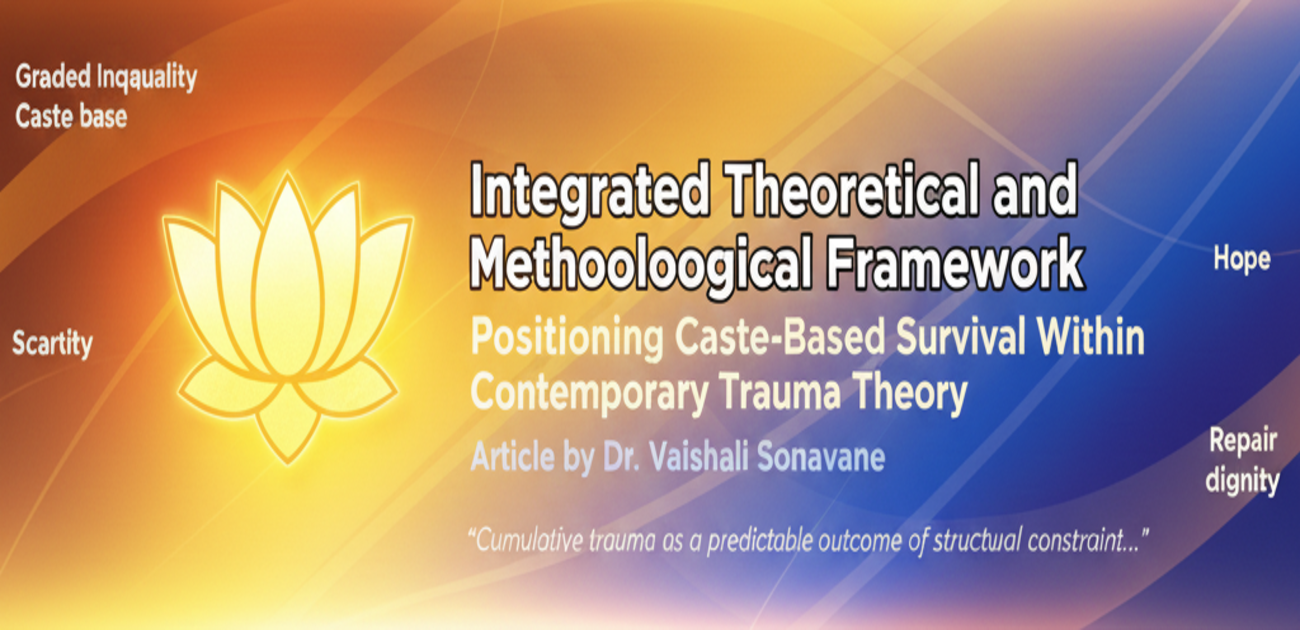
Contemporary trauma frameworks, such as complex trauma, Disorders of Extreme Stress Not Otherwise Specified (DESNOS), and Cumulative Trauma Disorder (CTD), have established that psychological distress may arise from prolonged and repeated exposure to harm rather than discrete events. However, these models remain insufficiently theorised in relation to social structures that systematically organise exposure to deprivation.
This article advances a structural–relational framework for understanding trauma under caste-based survival regimes, integrating trauma science with anti-caste political thought and feminist political economy. Drawing on the works of B. R. Ambedkar and Jyotiba Phule, the paper conceptualises survival not as an individual coping state but as an organising logic produced by graded inequality, labour extraction, time scarcity, and chronic humiliation.
It argues that cumulative trauma is transmitted intergenerationally through relational practices shaped by scarcity—particularly in parenting, intimacy, and marriage—rather than through memory alone. By extending CTD through the concepts of survival regimes and relational transmission, the framework reframes Dalit distress as a predictable outcome of structural constraint rather than individual pathology. The paper concludes by proposing dignity, predictability, and relational repair as central analytic and clinical outcomes for trauma work in caste-oppressed contexts.
1. Theoretical Positioning: Caste, Survival, and Cumulative Trauma
Contemporary trauma theory has increasingly moved beyond event-based models toward frameworks that recognise prolonged, repeated, and relationally embedded harm. Concepts such as complex trauma, Disorders of Extreme Stress Not Otherwise Specified (DESNOS), and Cumulative Trauma Disorder (CTD) have been central to this shift (Herman, 1992; van der Kolk et al., 2005; Kira et al., 2012). These frameworks collectively establish that trauma can be developmental, identity-linked, and cumulative rather than episodic.
However, these models remain under-theorised in relation to social structures that organise exposure to harm. They describe patterns of dysregulation but often do not adequately explain why certain populations are continuously placed in conditions of extreme stress. This gap is particularly evident in caste-based societies, where violence, deprivation, and humiliation are not exceptional events but enduring social conditions.
This framework extends existing trauma theories by explicitly locating cumulative trauma within caste, gendered labour, and political economy, arguing that Dalit distress emerges from institutionalised survival regimes rather than discrete traumatic experiences.
2. Complex Trauma and DESNOS: Contributions and Constraints
Complex trauma and DESNOS frameworks identify core domains of impact arising from chronic interpersonal harm, including affect dysregulation, disrupted attachment, altered self-concept, somatic distress, and relational instability (Herman, 1992; van der Kolk et al., 2005). These contributions are foundational for understanding how early and sustained adversity reorganises psychological and relational functioning.
Yet, their analytic focus largely remains at the level of interpersonal pathology, with limited attention to the social structures that produce chronic exposure. In caste-oppressed contexts, stress is not confined to family or early life alone; it is reinforced across institutions such as labour markets, education, housing, and public space. As a result, DESNOS and complex trauma models, while descriptively accurate, are insufficiently explanatory without a structural lens.
3. Cumulative Trauma Disorder (CTD) as a Conceptual Bridge
The CTD model (Kira et al., 2012) offers a critical conceptual advance by theorising trauma as additive, layered, and identity-linked. Developed with refugees, torture survivors, and racialised minorities, CTD recognises that mental distress often results from the accumulation of multiple trauma types across the lifespan rather than from singular catastrophic events.
CTD is particularly relevant for caste-based analysis for three reasons. First, it rejects the assumption of a post-trauma phase, aligning with caste realities where threat and humiliation are continuous. Second, it acknowledges identity-based exposure, making it compatible with caste as an inherited and socially enforced status. Third, it accounts for cross-domain disruption—affective, cognitive, relational, and existential—mirroring the diffuse nature of caste-related distress.
However, CTD remains primarily descriptive in relation to causality. While it identifies cumulative exposure, it does not fully theorise the systems that guarantee accumulation. This framework, therefore, builds on CTD by specifying caste, labour extraction, and gendered care as mechanisms through which cumulative trauma is produced and maintained.
4. Survival Regimes: Scarcity as the Organising Logic of Life
This framework conceptualises survival not as an episodic response to threat but as an organising logic produced by caste-based deprivation. Drawing on Ambedkar’s analysis of graded inequality and Phule’s critique of labour and educational exclusion, survival is understood as a structurally induced condition marked by chronic scarcity of security, time, and dignity (Ambedkar, 1936/2014; Phule, 1873/2002).
What shapes functioning is not only what was available—care, protection, predictability—but also what was systematically absent. These absences organise expectation, attachment, and action across the life course (Bowlby, 1988; van der Kolk, 2014). Under such conditions, neurobiological stress responses are repeatedly activated, producing vigilance, urgency, and endurance as adaptive norms rather than individual pathology (McEwen, 2007; Maté, 2010).
5. Relational Transmission Under Scarcity
Survival regimes reorganise relationships by translating structural scarcity into everyday relational practice. In parenting, especially among Dalit women carrying continuous paid and unpaid labour, time scarcity produces structural unavailability rather than emotional neglect (Phule, 1873/2002; Rege, 1998). Children’s heightened attachment-seeking under such conditions intensifies caregiver overload, escalating mutual dysregulation.
Harsh responses that emerge here reflect overextended survival capacity rather than moral failure (Scheper-Hughes, 1992; Maté, 2010). What is transmitted intergenerationally is not trauma memory alone but relational rules shaped by deprivation—what can be asked for, what must be endured, and what is assumed to be unavailable. Scarcity becomes relational instruction (Danieli, 1998; Kira et al., 2012).
6. Survival Regimes and Adult Relationships
In adulthood, survival logic continues to organise intimacy and partnership. Relationships formed under caste survival conditions are often characterised by fear of dependence, hyper-responsibility or withdrawal, and conflict experienced as a threat rather than a difference.
Marriage frequently functions as a stabilising survival institution—structuring economic security and social legitimacy—rather than as a site of mutual growth. Ambedkar’s critique of Hindu marriage highlights how Dalit women are positioned as shock absorbers within caste society, expected to endure without reciprocal care (Ambedkar, 1916/2011). These patterns are best understood as continuations of survival training under cumulative structural stress, not as attachment deficits or personal failures (Herman, 1992; van der Kolk, 2014).
7. Dalit Feminist Political Economy: Locating Causality
A defining contribution of this framework is the integration of Dalit feminist political economy, which situates trauma accumulation within caste-based labour extraction, gendered care burdens, time poverty, and chronic humiliation. Dalit women, in particular, often function as buffers for systemic failure, absorbing cumulative stress that is later misinterpreted as individual or familial dysfunction (Rege, 1998; Federici, 2012).
By politicising trauma accumulation, this approach challenges clinical neutrality and reframes therapeutic goals. Distress is not treated as maladaptation but as evidence of prolonged exposure to structurally organised harm. Consequently, dignity, rather than symptom reduction alone, becomes the primary analytic and clinical outcome.
8. Methods–Theory Bridge: Translating Structure into Research Practice
Epistemological Orientation
This framework is grounded in a critical–interpretive epistemology informed by Dalit feminist standpoint theory. It rejects the assumption that psychological distress can be understood independently of historical and political context. Methods are therefore selected to capture cumulative, relational, and structural phenomena rather than isolated symptoms.
Limits of Existing Measures
While standard PTSD instruments are constrained by event-based assumptions, CTD provides a more suitable conceptual scaffold for structurally traumatised populations. However, CTD scales alone cannot capture caste-specific mechanisms such as labour exploitation, time scarcity, and relational endurance. Accordingly, CTD is used here as a theoretical anchor rather than a diagnostic endpoint.
Operationalising Survival
Survival is operationalised as a structurally induced mode of functioning characterised by chronic vigilance, constrained choice, relational contraction, and endurance-based roles. Methodologically, this requires narrative and relational mapping, attention to absence (time, safety, choice), and contextual assessment of caste exposure and labour burden.
Relational Units of Analysis
In contrast to individual-centric trauma studies, this framework treats relationships as primary analytic units. Parenting, intimacy, and marriage are examined as sites where cumulative trauma is transmitted, concentrated, and sometimes interrupted.
Analytic Strategy and Rigour
Analysis links lived experience to structural location, focusing on adaptive logic under constraint rather than pathology. Rigour is established through theoretical coherence, reflexivity, and explicit structural attribution, resisting false neutrality.
9. Toward a Dignity-Oriented Trauma Framework
This integrated framework does not reject complex trauma, DESNOS, or CTD models. It extends them by embedding cumulative trauma within caste-based survival regimes, relational transmission, and political economy.
Healing is conceptualised not as the erasure of survival adaptations but as the loosening of survival dominance as conditions of dignity—predictability, choice, non-humiliation, and capacity for restoration—become possible. In doing so, the framework offers a structural–relational approach capable of accounting for caste-based distress while resisting pathologisation, and provides a replicable model for research and practice with other structurally marginalised populations.
References
- Ambedkar, B. R. (1916/2011). Castes in India: Their mechanism, genesis and development. Columbia University.
- Ambedkar, B. R. (1936/2014). Annihilation of caste. Navayana.
- Ambedkar, B. R. (1948/2014). The untouchables: Who were they and why they became untouchables? Navayana.
- Bowlby, J. (1988). A secure base: Parent-child attachment and healthy human development. Basic Books.
- Danieli, Y. (1998). International handbook of multigenerational legacies of trauma. Plenum Press.
- Federici, S. (2012). Revolution at point zero: Housework, reproduction, and feminist struggle. PM Press.
- Herman, J. L. (1992). Trauma and recovery. Basic Books.
- Kira, I. A., Templin, T., Lewandowski, L., Ashby, J. S., Oladele, A., & Odenat, L. (2012). Cumulative trauma disorder scale: Two studies. Psychology, 3(9), 643–656.
- Maté, G. (2010). In the realm of hungry ghosts: Close encounters with addiction. North Atlantic Books.
- McEwen, B. S. (2007). Physiology and neurobiology of stress and adaptation: Central role of the brain. Physiological Reviews, 87(3), 873–904.
- Phule, J. (1873/2002). Gulamgiri (Slavery). SAGE.
- Rege, S. (1998). Dalit women talk differently: A critique of ‘difference’ and towards a Dalit feminist standpoint position. Economic and Political Weekly, 33(44), WS39–WS46.
- Scheper-Hughes, N. (1992). Death without weeping: The violence of everyday life in Brazil. University of California Press.
- Van der Kolk, B. A. (2014). The body keeps the score: Brain, mind, and body in the healing of trauma. Penguin Books.
Comments
3 responses to “Integrated Theoretical and Methodological FrameworkPositioning Caste-Based Survival Within Contemporary Trauma Theory”
[…] V. (2025). Caste based survival trauma framework. [cite_start]https://drvaishalisonavane.com/caste-based-survival-trauma-framework/ [cite: […]
[…] Sonavane, V. (2025). Integrated theoretical and methodological framework: Positioning caste-based survival within contemporary trauma theory. Available at: https://drvaishalisonavane.com/caste-based-survival-trauma-framework/ […]
[…] Sonavane, V. (2025). Integrated theoretical and methodological framework: Positioning caste-based survival within contemporary trauma theory. Available at https://drvaishalisonavane.com/caste-based-survival-trauma-framework/ […]