
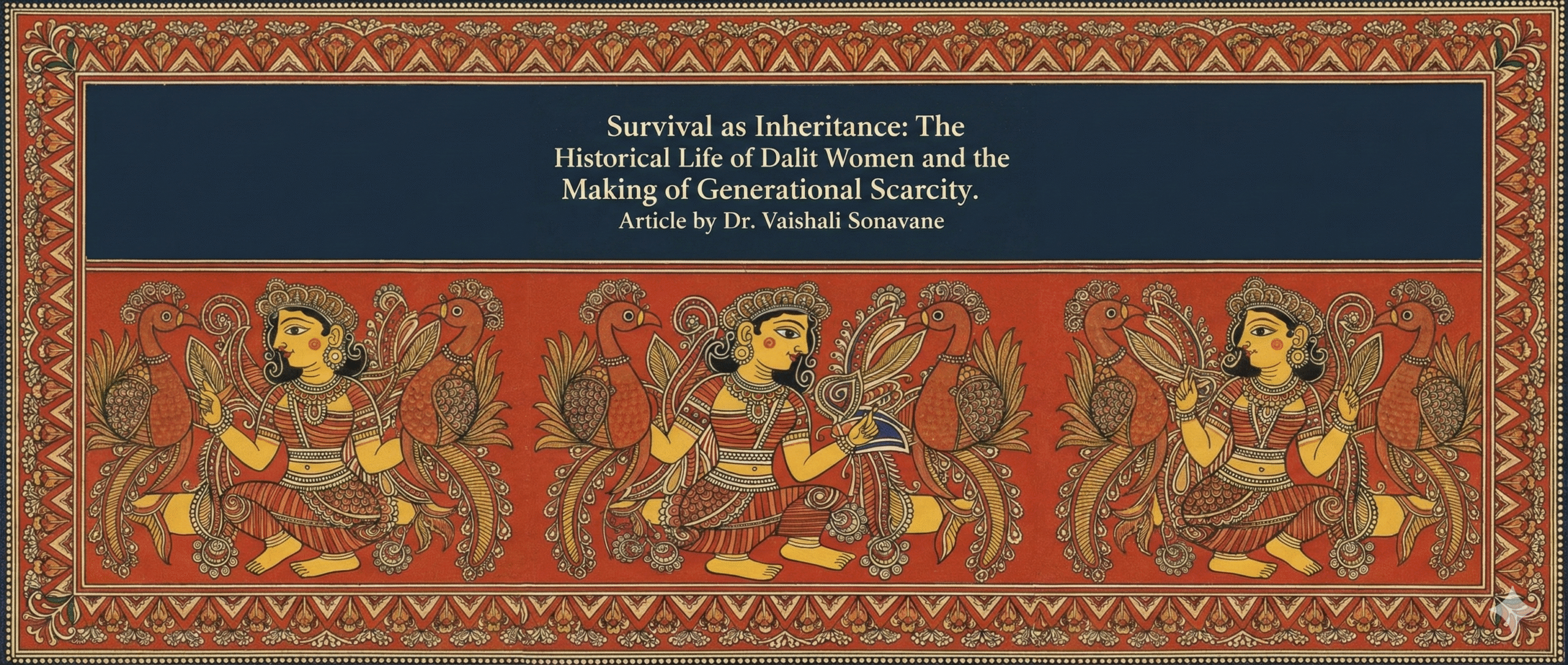
(This article examines historically produced survival regimes among Dalit women. Dalit women who have broken these structures and are thriving beyond them will be taken up in a subsequent article.)
By Dr. Vaishali Sonavane
Abstract
This article examines how survival among Dalit women is historically produced, relationally transmitted, and structurally enforced, creating intergenerational patterns of scarcity and adaptive psychological strategies. Drawing on Dalit women’s life writing, Dalit feminist scholarship, legal critiques, liberation psychology, and Black feminist survival theory, it argues that survival is not an episodic crisis but the ambient condition of life shaped by caste, gendered exploitation, and economic precarity.
Time scarcity, bodily labour without accumulation, sexual vulnerability, institutional betrayal, and relational pedagogy produce emotional restraint, hypervigilance, early self-regulation, and constrained parenting practices—behaviours often misread as dysfunction but in context reflecting adaptive intelligence. These adaptations are learned, embodied, and transmitted across generations, forming a coherent survival logic. The analysis situates Dalit women’s psychological life within caste patriarchy and political economy, highlighting the ethical imperative to create time, dignity, and nervous-system safety as prerequisites for wellbeing beyond mere survival.
Survival Without Pause: Everyday Life as Structural Violence
For Dalit women, survival is not an episodic crisis to be overcome; it is the ambient condition of existence, a continuous affective economy produced by caste violence, gendered labour, and economic precarity. Each day begins before sunrise, with domestic work, water and fuel collection, child care, and animal tending. It continues through wage or farm labour, performed under surveillance, scorn, and sexual vulnerability, and ends only late at night, to repeat without pause.
This absence of temporal reprieve is not incidental; it is structurally enforced. Survival operates as the organising logic that trains attention, emotion, and bodily regulation into endurance, shaping the psychological rhythms of life itself.
From a psychological perspective, this unrelenting regimen produces a chronic state of hyper-arousal, anticipatory vigilance, and embodied endurance. Emotional availability and relational responsiveness are constrained, not through incapacity but through structural depletion of time, energy, and safety. Cognitive and affective capacities are constantly directed toward threat detection, social negotiation, and survival, producing what might appear externally as emotional restraint, hyper-independence, or over-control—but in context, these are functional adaptations, not deficits.
Indian feminist political economy long demonstrates how women’s labour is systematically invisible and undervalued (Agarwal, 1994). For Dalit women, caste compounds this invisibility: work is hyper-extracted and socially erased, reinforcing the psychological internalisation of marginalisation. Caste and gender do not operate as parallel axes but as mutually constitutive systems that structure labour, surveillance, humiliation, and embodied constraint across everyday life (Kannabiran, 2025; Sonavane, 2025). What appears mundane—fetching water, performing agricultural tasks, enduring social contempt—is historically sedimented structural violence, experienced as normalcy and misread by outsiders as culture or routine.
Dalit women’s autobiographical writing makes the psychological interiority of this structural violence visible. In Jina Amucha, Baby Tai Kamble describes how ‘Mahar’ girls sat on the floor in school while non Dalit-caste children occupied benches, absorbing caste contempt as ordinary, shaping early expectations of inferiority, and training bodies to inhabit subordination before consciousness of oppression (Kamble, 1982/2008). Aaydan traces Urmila Pawar’s early exposure to relentless domestic and wage labour, caste shaming within and outside the community, and maternal emotional containment—revealing how humiliation and exhaustion are transmitted relationally and embodied psychologically (Pawar, 2003/2009).
These narratives illuminate that structural violence is not experienced as isolated events but as a continuous, relational, and embodied world, shaping attention comprehension, affect, and self-concept from childhood onward. Children learn self-regulation, emotional compression, and anticipatory vigilance not through explicit instruction but through the pedagogy of daily life, where scarcity, monitoring, and social censure are constant teachers. The body and nervous system themselves become repositories of caste-inflected survival knowledge, producing psychological patterns that are adaptive, relational, and historically enforced.
In this framework, Dalit women’s psychological life is inseparable from the politics of time, dignity, and nervous-system safety—core principles emphasised by Ease Revolution and Alchemy Healing Hub. Their affective worlds, cognitive strategies, and relational behaviours cannot be disentangled from the rhythms of structural oppression. Emotional endurance, vigilance, and relational negotiation are not merely coping mechanisms; they are the embodiment of survival intelligence, forged through intergenerationally transmitted practices and daily confrontation with systemic injustice.
Dalit Feminist Theory as Situated Knowledge
Dalit feminist theory emerges from the lived realities, intellectual work, and activism of Dalit women themselves. It does not abstractly universalise women’s experiences but insists that caste is the organising logic of gendered life in India, inseparable from any analysis of oppression, labour, or psychological experience (Arya & Rathore, 2020; Dalit Feminist Discourse, 2025; Sonavane, 2025). Unlike frameworks that centre only gender, upper-caste perspectives, or normative psychological categories, Dalit feminist scholarship foregrounds historically and socially produced inequalities, highlighting the structural conditions that produce hypervigilance, emotional restraint, and endurance as adaptive survival intelligence.
This theoretical stance is informed by multiple forms of knowledge production: autobiographies, poetry, oral histories, and activist interventions. Dalit women’s writing, such as Kamble’s Jina Amucha and Pawar’s Aaydan, constitutes an epistemic project; the articulation of lived experience as evidence of structural violence and survival intelligence. Psychological phenomena—fear, silence, bodily vigilance—are reframed not as deficits but as embodied responses to caste hierarchy, reinforced across daily life and across generations (Kamble, 1982/2008; Pawar, 2003/2009; Sonavane, 2025).
This scholarship critiques mainstream feminist narratives that have historically homogenised women’s oppression from upper-caste or elite positionalities, erasing Bahujan, Adivasi, Dalit, and minority women from universalisations of gendered suffering (Arya & Rathore, 2020; Dalit Feminist Discourse, 2025). It insists that psychological adaptations and relational strategies among Dalit women—emotional containment, hyper-alertness, premature responsibility—cannot be understood without reference to caste, historical exclusion, economic precarity, and institutional betrayal.
Dalit feminist theory also challenges epistemic gatekeeping within psychology and social sciences. It asserts that interventions that ignore structural conditions risk pathologising survival intelligence. For instance, mainstream psychology may label emotional restraint or hyper-independence as maladaptive, yet from a Dalit feminist and liberation-informed perspective, these are strategic, learned, and historically enforced competencies (Collins, 2000; Comas-Díaz, 2016; Sonavane, 2025).
Autobiographical and oral histories further perform a counter-archive function, documenting everyday practices of survival, endurance, and relational intelligence under structural oppression. These narratives illustrate how survival is socially taught—through parental guidance, community norms, and intergenerational transmission—rather than individually chosen. The knowledge encoded in these practices is psychologically and politically coherent, and forms the basis of an adaptive epistemic habitus that enables life under conditions of scarcity, danger, and institutional betrayal (Freire, 1970; Foucault, 1980; Kannabiran, 2025).
Integrating non-Dalit feminist insights, such as Black feminist survival theory, liberation psychology, and political economy, Dalit feminist scholarship enriches our understanding of adaptive intelligence, resilience, and structural trauma. Black feminist theory situates survival as permanent and relational (Collins, 2000), while liberation psychology reframes distress as structurally produced rather than individually pathological (Comas-Díaz, 2016). Together, these frameworks underscore that Dalit women’s psychological strategies are functional, contextually rational, and politically intelligible, and that interventions must prioritise time, dignity, and nervous-system safety—principles central to Ease Revolution and Alchemy Healing Hub.
In essence, Dalit feminist theory reframes psychological life as situated knowledge; it recognises that the everyday cognition, emotion, and relational patterns of Dalit women are inseparable from caste, poverty, gendered labour, and intergenerational survival. These insights provide a critical foundation for designing trauma-informed, culturally situated, and justice-oriented interventions that value survival intelligence while seeking structural transformation (Sonavane, 2025).
Disciplined Survival: Eight Structuring Dynamics of Psychological Life
Dalit women’s psychological worlds are not shaped by isolated stressors but by a patterned regime of disciplined survival—normative states that organise emotion, attention, cognition, and relational life around endurance, vigilance, and strategic self-preservation. These dynamics are historically produced, politically enforced, and socially transmitted across generations, producing a coherent survival logic that mainstream frameworks often misread as dysfunction.
- Time Scarcity as Structural Control: Chronic and overlapping labour demands, compounded by caregiving, domestic work, and wage or agricultural labour, fragment the day and deny temporal autonomy. This structural deprivation keeps nervous systems in persistent mobilisation, limiting reflection, creativity, and emotional recovery (Agarwal, 1994; Kannabiran, 2025; Sonavane, 2025). Time scarcity functions as political violence; it shapes rhythm, attention, and possibility, producing endurance as habit and vigilance as necessity.
- Emotional Compression and Strategic Containment: Silence, restraint, and controlled expression are adaptive strategies to navigate surveillance, humiliation, and threat. Emotional containment is relationally intelligent; it prevents exposure to social, caste, and gendered violence while regulating interpersonal interactions (Rege, 1998; Collins, 2000). What may appear as detachment or inhibition is, in context, a learned protective mechanism, calibrated over time and across environments.
- Premature Responsibility and Early Self-Regulation: Children acquire accelerated maturity and self-sufficiency to meet the demands of survival, often assuming adult responsibilities before psychological readiness. This hyper-independence and early emotional regulation are functional, not pathological, equipping individuals to manage scarcity, anticipate danger, and ensure household continuity (Comas-Díaz, 2016; Sonavane, 2025).
- Hypervigilance as Learned Orientation: Persistent exposure to caste hostility, economic precarity, and social devaluation trains attention toward potential threats. Hyper-alertness, anticipatory caution, and avoidance are stabilising strategies within a world that consistently signals risk (Foucault, 1980; Ambedkar, 1936/2014). Such vigilance is not anxiety in isolation but contextually rational adaptation to hostile environments.
- Dignity as Precarious: Social devaluation teaches that dignity must be claimed, defended, and guarded rather than assumed or inherent. Everyday encounters—ranging from humiliating labour to microaggressions and systemic disrespect—structure self-perception and relational norms, producing careful negotiation, restraint, and protective comportment (Chakravarti, 2003; Rege, 1998). Parenting transmits this sense of precarious dignity, shaping children’s relational intelligence and ethical reasoning under constraint.
- Labour Without Accumulation: Women’s labour, whether domestic, agricultural, or wage-based, rarely converts into economic security or social mobility. Work produces endurance and functional capacity, but not long-term resources. This structural pattern shapes aspiration, temporal planning, and psychological orientation toward survival rather than flourishing (Ambedkar, 1936/2014).
- Sexual Vulnerability as Structural Discipline: Threat of sexual coercion and caste-based policing of women’s bodies regulates behaviour and mobility. Institutional responses, including legal frameworks and social norms, often obscure systemic violence, reinforcing compliance, self-surveillance, and behavioural containment (Ambedkar, 1916/2011; Kannabiran, 1991). Hyper-alertness, bodily restraint, and strategic silence are learned responses, historically enforced across generations.
- Institutional Betrayal and the Pedagogy of Silence: Repeated failures of law, delayed justice, victim-blaming, and social impunity teach that endurance and silence are safer than complaint or resistance. Children internalise these lessons vicariously, producing intergenerational patterns of anticipation, caution, and self-reliance (Freire, 1970; Kannabiran, 2025). Institutional betrayal reinforces the epistemic habitus of survival, making endurance intelligible and rational within structural constraints.
Collectively, these eight dynamics produce a psychologically coherent survival regime. Emotion, cognition, and relationality are organised around endurance and vigilance, forming an epistemic habitus; a learned orientation to the world that is rational, contextually intelligent, and socially necessary, yet frequently misinterpreted as dysfunction in mainstream psychological frameworks. These patterns are intergenerational, historically sedimented, and politically enforced, illustrating the profound depth of disciplined survival in Dalit women’s lives.
Power, Pedagogy, and Psychological Formation
Michel Foucault’s analysis of power reveals that power does more than repress; it produces subjectivity by shaping desires, emotions, and self-understanding (Foucault, 1980). In caste society, emotional regulation — silence, endurance, containment — is adaptive. Paulo Freire’s pedagogy of the oppressed explains how subjugation teaches survival behaviours that later appear as personality traits (Freire, 1970).
Dalit feminist thought insists that caste patriarchy is not incidental but engineered to deny dignity, autonomy, and mobility across generations (Ambedkar, 1916/2011; 1936/2014; 1948/2014). Kalpana Kannabiran demonstrates that legal systems often individualise caste gender violence, failing to address its structural roots and thereby reproducing institutional impunity (Kannabiran, 2025). Psychological life — self-perception, attachment, regulation — develops within this pedagogy of powerlessness, continuously reinforced by law, culture, economy, and everyday social practice.
Intergenerational Transmission: How Survival Becomes Inherited Psychology
Adaptive psychological patterns are transmitted across generations. Parenting under extreme time scarcity, overlapping domains of labour, and structural exhaustion produces early self-regulation, emotional compression, and vigilance (Agarwal, 1994; Rege, 1998; Collins, 2000; Comas-Díaz, 2016; Sonavane, 2025). Silence, restraint, and hyper-alertness are embodied lessons in survival. Oppression functions pedagogically: children learn not only through words but through body posture, relational patterns, time scarcity, and emotional containment (Freire, 1970; Foucault, 1980).
Material deprivation and caste barriers to education and assets force prioritisation of endurance over exploration, safety over curiosity, obedience over self-expression (Ambedkar, 1936/2014; Sangari, 1995). Institutional betrayal reinforces that silence and endurance are safer than seeking justice (Kannabiran, 2025). Children internalise these survival logics long before they learn names for caste or oppression. Intergenerational transmission thus reflects preparedness for a structurally hostile world — not pathology (Collins, 2000; Comas-Díaz, 2016; Sonavane, 2025).
Adaptive Psychology, Not Deficit
Dalit women exhibit adaptive intelligence born of structural violence. Emotional restraint, hypervigilance, and early responsibility are not signs of pathology but functional responses to environments shaped by caste oppression, gendered exploitation, and material scarcity (Collins, 2000; Comas-Díaz, 2016). These behaviours are learned and reinforced from early childhood through relational pedagogy, observation, and embodied practice, ensuring survival in conditions where deviation from expected roles can invite physical, social, or economic punishment.
Power and social structures inscribe themselves into subjectivity: the body, attention, and emotional regulation are continuously trained to anticipate threat, manage scarcity, and navigate social hierarchies (Foucault, 1980). Survival logic becomes embodied, shaping nervous-system responses that regulate alertness, vigilance, and emotional containment long before individuals consciously understand the constraints they live under.
Mainstream psychology, trained to read behaviours in isolation from social context, frequently labels these adaptations as dysfunction. What appears as emotional distance, hyper-independence, or over-control is, in this frame, disciplined survival. This adaptation is also intergenerational. Children absorb the rhythms of constraint, self-regulation, and cautious engagement as normative, internalising survival strategies from their caregivers and community (Freire, 1970; Ambedkar, 1936/2014; Sonavane, 2025).
In this sense, adaptive psychology is not just a personal trait but a collective inheritance, sculpted by historical exclusion, institutional betrayal, and continuous structural pressures. Recognising these patterns as intelligent responses to oppression, rather than deficits, challenges both clinical assumptions and social misinterpretations, and reframes the ethical question; how can structures be transformed so that adaptive survival intelligence no longer remains the only path to safety, dignity, and life itself? (Kannabiran, 2025).
Conclusion
Dalit women do not require better coping strategies; they require less structural burden and more dignity. Thriving emerges only when time, safety, choice, and recognition replace survival as the organising principle of life. Until such structural transformation, behaviours misread as dysfunction must be understood as adaptive intelligence under oppression. This article politicises everyday Dalit women’s lives, showing how caste, gender, poverty, and power produce intergenerational survival regimes. Subsequent work will examine Dalit women who have broken these chains and the structural conditions enabling such rupture.
References
- Agarwal, B. (1994). A field of one’s own: Gender and land rights in South Asia. Cambridge University Press.
- Ambedkar, B. R. (1916/2011). Castes in India: Their mechanism, genesis and development. Columbia University.
- Ambedkar, B. R. (1936/2014). Annihilation of caste. Navayana.
- Ambedkar, B. R. (1948/2014). The untouchables: Who were they and why they became untouchables? Navayana.
- Arya, S., & Rathore, A. S. (Eds.). (2020). Dalit feminist theory: A reader. Routledge.
- Collins, P. H. (2000). Black feminist thought: Knowledge, consciousness, and the politics of empowerment (2nd ed.). Routledge.
- Comas-Díaz, L. (2016). Multicultural care: A liberation psychology perspective. American Psychologist, 71(1), 43–56. [cite_start]https://doi.org/10.1037/a0039590 [cite: 332]
- Dalit Feminist Discourse: Voices in Dalit Narratives (Arya & Deka, Eds.). (2025). Routledge.
- Foucault, M. (1980). Power/knowledge: Selected interviews and other writings 1972–1977. Pantheon Books.
- Freire, P. (1970). Pedagogy of the oppressed. Continuum.
- Kannabiran, K. (1991). Caste and gender: Understanding dynamics of power and violence. Economic and Political Weekly, 26(37), 2130–2133.
- Kannabiran, K. (2025). From text to praxis: Legal theory, caste, and feminist thought. Doing Sociology. https://doingsociology.org/2025/12/20/from-text-to-praxis-kalpana-kannabiran-on-legal-theory-caste-and-feminist-thought/
- Kamble, B. T. (1982/2008). Jina Amucha (The prisons we broke) (M. Pandit, Trans.). Orient BlackSwan.
- Pawar, U. (2003/2009). Aaydan: The weave of my life (M. Pandit, Trans.). Columbia University Press.
- Rege, S. (1998). Dalit women talk differently: A critique of ‘difference’ and towards a Dalit feminist standpoint position. Economic and Political Weekly, 33(44), WS39–WS46.
- Sangari, K. (1995). Politics of diversity. Economic and Political Weekly, 30(51), 3287–3310.
- Sonavane, V. (2025). Caste based survival trauma framework. [cite_start]https://drvaishalisonavane.com/caste-based-survival-trauma-framework/ [cite: 343]
- van der Kolk, B. (2014). The body keeps the score: Brain, mind, and body in the healing of trauma. Penguin Books.
Comments
4 responses to “Survival as Inheritance: The Historical Life of Dalit Women and the Making of Generational Scarcity”
[…] Sonavane, V. (2025). Survival as inheritance: The historical life of Dalit women and the making of generational scarcity. Available at: https://drvaishalisonavane.com/survival-as-inheritance-dalit-women/ […]
[…] Sonavane, V. (2025). Survival as inheritance: The historical life of Dalit women and the making of generational scarcity. Available at https://drvaishalisonavane.com/survival-as-inheritance-dalit-women/ […]
Heya i’m for the primary time here. I found this board and I to find It really helpful & it helped me out a lot. I’m hoping to offer one thing back and aid others like you aided me.
Welcome, and thank you for your thoughtful message.
I’m glad the work here has been helpful to you. If it has supported your thinking or reflection in any way, that itself matters.
You’re most welcome to continue engaging with the ideas here. Thoughtful dialogue and sustained reflection are how we collectively deepen understanding.
Wishing you well in your own journey.
Warm regards,
Dr. Vaishali Sonavane