
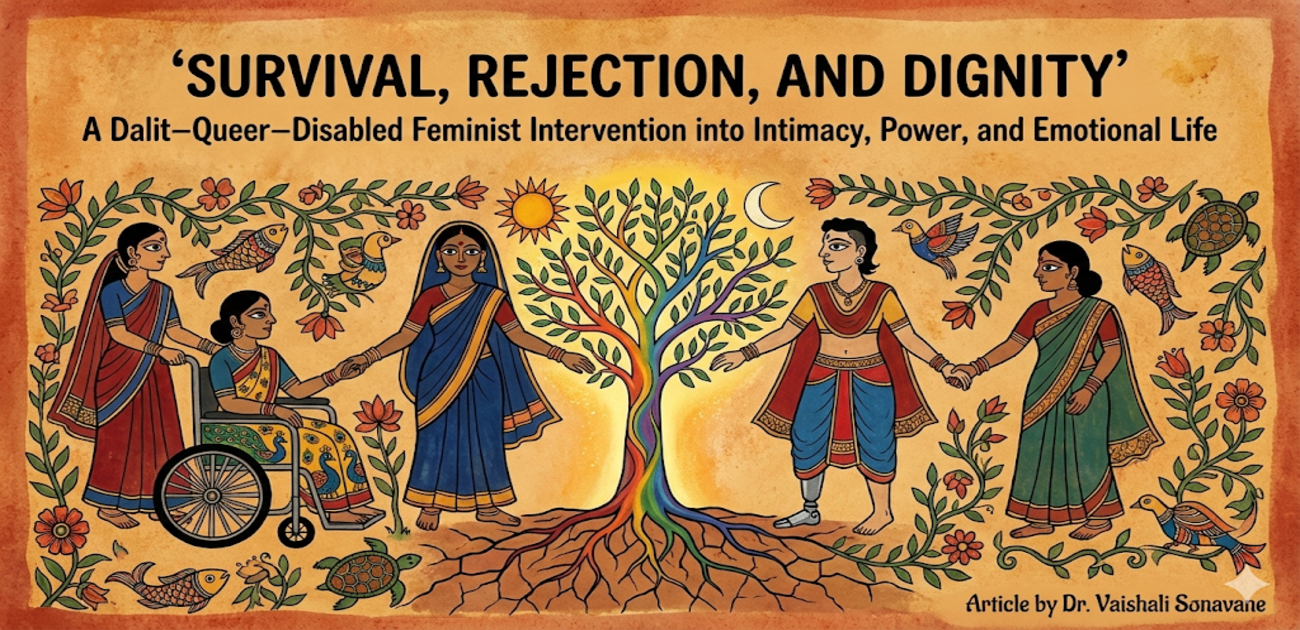
Article by Dr. Vaishali Sonavane
Abstract
This article develops a Dalit–Queer–Disabled feminist framework to understand survival, rejection, and relational harm as structurally produced conditions rather than individual failures. Drawing from Ambedkarite anti-caste movement, queer and disabled feminist scholarship, trauma and attachment theory, and critical theories of power, the paper examines how caste, gender, sexuality, disability, poverty, and location shape intimate relationships, selfhood, and emotional life. Survival is theorised as a historically inherited orientation that organises desire, attachment, labour, and love under conditions of scarcity and exclusion. Rejection—romantic, familial, institutional, and social—is positioned as a core state of being for marginalised communities rather than an episodic experience. The article argues for a shift from survival-based partnerships to dignified relationality through politicised emotional literacy, collective re-anchoring, and an ethical re-imagination of intimacy.
Keywords: survival, rejection, caste, Dalit feminism, queer intimacy, disability, emotional life, dignity, power
Introduction: Survival as a Condition, not a Choice
For many marginalised communities, survival is not a phase to be outgrown but a structural inheritance. Dalit men-women-queer and sexual minorities, disabled persons, and those raised in conditions of poverty learn early that safety is conditional, love is negotiable, and belonging must be earned. Under such conditions, emotional life is organised around vigilance rather than trust, endurance rather than ease, and accommodation rather than mutuality. These orientations are not merely psychological dispositions; they are historically and politically produced survival formations and structurally induced trauma responses, forged through prolonged and intergenerational exposure to caste-based domination, gender regulation, heteronormative normality, and ableist governance. These regimes organise social life through graded inequality, caste-coded sexual and gendered control, and routinised, sanctioned harm, compelling adaptation as a condition of survival rather than as an expression of individual choice.
This article argues that survival and rejection must be understood as politically produced states of being rather than as isolated personal experiences or interpersonal misfortunes. Rejection—by family, caste location, intimate partners, institutions, and the nation-state—functions as a disciplining force that shapes attachment patterns, relational expectations, and internalised self-worth. Intimate relationships thus emerge as critical sites where structural power is reproduced, negotiated, resisted, and often endured.
As Freire (2000, p. 48) observes, “The oppressed, having internalized the image of the oppressor and adopted his guidelines, are fearful of freedom.” Similarly, Ambedkar (1936/2004) underscores the structural intractability of caste, “It is not possible to break Caste without annihilating the religious notions on which it, the Caste system, is founded.”
Both thinkers locate fear, constraint, and endurance not within the individual psyche but within historically sedimented structures of domination. Placed in dialogue, these interventions reframe survival not as personal resilience or moral strength but as a political condition—one that organises emotional life, relational expectations, and the very limits of intimacy. Positioned explicitly as a Dalit–Queer–Disabled feminist intervention, this work decentres dominant therapeutic, liberal, and individualised frameworks that pathopathologise distress while leaving oppressive structures intact. Instead, it advances an integrated political–psychological analysis of intimacy under conditions of caste, gendered, sexual, and ableist domination, foregrounding how emotional life itself is structured by inequality.
Positionality
This work is grounded in a situated standpoint shaped by caste, gender, and sustained engagement with trauma-informed, community-based, and structural frameworks. Writing from an Ambedkarite feminist orientation, the author locates herself within ongoing struggles against caste domination, gendered marginalisation, and normative regulation of relational life. This positionality informs a sustained analytical commitment to dignity, structural accountability, and a refusal to pathologise harm that is produced and maintained by social systems. Rather than claiming neutrality, the article treats location as both a methodological resource and an ethical obligation, foregrounding how lived experience shapes the questions asked, the concepts mobilised, and the interpretations offered.
Survival, Attachment, and the Making of Relational Scarcity
Attachment theory demonstrates how early relational environments shape expectations of safety, availability, and connection (Mikulincer & Shaver, 2016). However, when childhood itself is structured by caste humiliation, material deprivation, gendered violence, or disability-based neglect, insecure attachment is not an anomaly—it is an adaptive response to chronic and cumulative threat. In such contexts, hypervigilance, emotional suppression, and relational over-accommodation function as survival strategies rather than developmental deficits.
Research on childhood poverty and chronic stress shows how material and social scarcity reorganise emotional regulation, decision-making, and relational strategies across the life course (Evans & Kim, 2013; Desai & Dubey, 2012). For Dalit and other marginalised children, this scarcity is intensified by social devaluation, institutional abandonment, and routine experiences of humiliation. Survival thus becomes the organising principle of intimacy itself, shaping how love is sought, sustained, and endured. Individuals emerging from such conditions often enter adulthood carrying a deep fear of abandonment and disposability. This frequently manifests as people-pleasing, excessive emotional labour, over-functioning, and a high tolerance for neglect or asymmetry within relationships. Intimacy, under these conditions, is pursued not as mutual recognition or pleasure but as temporary shelter from existential insecurity.
Caste, Attachment, and the Political Production of Insecurity
Ambedkar in Annihilation of caste (1936), in point 11. Caste deprives Hindus of mutual help, trust, and fellow-feeling. Subpoint 3 articulates a structural logic of collective relational scarcity:
“The reasons which have made Shudhi impossible for Hindus are also responsible for making Sanghatan impossible. The idea underlying Sanghatan is to remove from the mind of the Hindu that timidity and cowardice which so painfully mark him off from the Mohammedan and the Sikh, and which have led him to adopt the low ways of treachery and cunning for protecting himself. The question naturally arises, from where does the Sikh or the Mohammedan derive his strength, which makes him brave and fearless? … It is due to the strength arising out of the feeling that all Sikhs will come to the rescue of a Sikh when he is in danger, and that all Mohammedans will rush to save a Muslim if he is attacked.”
Read through the lens of attachment theory, Ambedkar offers a profoundly structural account of how chronic social fragmentation produces insecurity at a collective relational level. Attachment security develops where there is a reliable expectation of protection, responsiveness, and rescue in moments of vulnerability (Mikulincer & Shaver, 2016). Ambedkar’s insistence that caste deprives people of the assurance that “all will come to the rescue” names precisely the absence of a secure relational base—where bodies are instead subjected to systemic violence, social abandonment, and targeted exclusion, often with life-threatening consequences for Dalits.
Where no collective figure—family, community, or social body—can be trusted to respond, individuals learn hypervigilance, strategic compliance, emotional withdrawal, and self-protective calculation as necessary survival adaptations. What attachment theory identifies as anxious or avoidant patterns thus appear not as individual pathologies but as rational, historically conditioned responses to a caste-structured world organised around abandonment rather than care.
Ambedkar’s contrast with Sikh and Muslim communities is analytically instructive. The courage he attributes to them does not arise from moral superiority or physical strength but from secure relational expectation—the knowledge that one will not be left alone when threatened. Under caste conditions, by contrast, the absence of such assurance trains subjects to expect withdrawal rather than protection, shaping intimacy, emotional regulation, and relational life around endurance instead of trust. Survival, in this sense, is relationally costly; it requires the contraction of expectation, the management of exposure, and the disciplined containment of need.
Bodily Dignity, Labour, and Enforced Care Scarcity
In Annihilation of Caste (1936), Ambedkar advances a theory of dignity that is inseparable from the material organisation of labour and social relations. He writes, “In an ideal society, there should be many interests consciously communicated and shared. There should be social endosmosis. This is fraternity, which is only another name for democracy” (p. 25). Against this ideal, caste functions as a regime that forecloses fraternity by fixing bodies into graded worth through work, “Caste is not a division of labour, it is a division of labourers” (p. 14).
Ambedkar thus exposes caste not as an abstract hierarchy but as a system that organises bodily endurance. Certain bodies are historically assigned to degrading, invisible, or polluting labour, rendering dignity structurally inaccessible rather than individually earned. Under these conditions, the body itself becomes a site of regulated survival—trained to tolerate humiliation, overwork, surveillance, and disposability in exchange for continued existence.
Attachment theory underscores that security emerges where care and protection are reliably available (Mikulincer & Shaver, 2016). When caste, poverty, heteronormativity, and ableism systematically organise care withdrawal, attachment security is undermined, producing hypervigilance, over-accommodation, self-erasure, and adaptive self-contraction. Disabled and queer bodies experience intensified relational scarcity through conditional inclusion, moral scrutiny, enforced dependency, and the constant threat of abandonment.
Ambedkar’s ethic of fraternity—what he names as social endosmosis—thus demands not moral reform but structural reorganisation of relational life. Dignity, in this framing, is collective rather than individual; attachment security is shared rather than privately earned; and care is a political responsibility rather than a discretionary act. Contemporary disability justice and queer-of-colour scholarship echo this demand, insisting that survival must be reorganised around mutual responsibility and collective access to care, rather than conditional usefulness or normative conformity (Mingus, 2011; Sins Invalid, 2016; Piepzna-Samarasinha, 2018).
Analytic Outcome
Placed in dialogue with trauma and attachment frameworks, Ambedkar’s work reveals caste as a regime that produces insecurity as a governing condition of life. It fragments the expectation of rescue, erodes trust as a social norm, and compels survival strategies that are later misrecognised as individual dysfunction or relational failure. Intimacy, under such conditions, becomes a site not of ease but of endurance—where attachment is shaped by caution, care is conditional, and vulnerability carries material risk.
This analysis reinforces the central argument of the article, that survival is not a personal trait or moral achievement but a politically produced state of being. To address relational distress without confronting caste, gendered, sexual, and ableist structures is to misname the source of harm. A Dalit–Queer–Disabled feminist framework, grounded in Ambedkar’s insistence on fraternity and dignity, thus requires a radical reimagining of care, attachment, and intimacy as collective, structural, and non-negotiable conditions of justice.
Access, Care, and Interdependence as Political Practices
Disability justice scholar Mia Mingus (2011) emphasises that access is never neutral; it is shaped by power and the perceived worth of bodies. Under conditions of ableist scarcity, disabled people must constantly negotiate care, intimacy, and survival, producing relational patterns marked by over-accommodation, fear of withdrawal, and constrained desire. Writing from within queer and disabled survival worlds, Piepzna-Samarasinha (2018) documents how love and care are often stretched beyond sustainability when state and community structures fail. Survival-based care, as she notes, is not evidence of intimacy but a symptom of structural abandonment, where emotional labour becomes a form of enforced endurance.
Disability justice movements further assert that interdependence is not a deficit to be overcome but a political refusal of abandonment. By centring collective access, shared vulnerability, and mutual accountability, dignity becomes relational rather than conditional, individualised, or earned (Sins Invalid, 2016). This framework situates intimacy, care, and relational labour within structural politics. For marginalised bodies, the very ability to be held, to receive care, and to participate in relationships is inseparable from broader struggles for social recognition, bodily dignity, and collective responsibility.
Rejection as a Core State of Being
Judith Butler’s work on grievability illuminates how certain lives are rendered unrecognisable, unworthy of care, and excluded from dominant frames of value (Butler, 2009). For Dalit, queer, and disabled bodies, rejection is not episodic but constitutive—a structuring condition that spans familial, romantic, institutional, and civic domains.
Shruti Chakravarty’s research on queer intimacies in India offers critical empirical insight into how desire, attachment, and relational practices are shaped by caste, class, and respectability (Chakravarty, 2020). Her work demonstrates that queer relationships are forged within conditions of erasure, lack of social sanction, and absence of relational role models—conditions that profoundly shape emotional labour, endurance, and expectations of abandonment. Repeated experiences of rejection generate an internalised sense of disposability. Individuals learn to accept being undervalued, overused, or emotionally neglected, often mistaking endurance for love and accommodation for intimacy.
Ambedkar’s refusal to compromise dignity in the face of institutional pressure captures the ethical stance required to inhabit such rejection, “I cannot give up, for the sake of pleasing the Mandal, the duty which every President owes to the Conference over which he presides, to give it a lead which he thinks right and proper.” (Ambedkar, Letter, April 27, 1936). Freire similarly frames liberation as praxis rather than accommodation, ‘Liberation is a praxis, the action and reflection of men and women upon their world in order to transform it.’ (Freire, 2000).
Conclusion: From Survival to Collective Dignity as Relational Praxis
Survival and rejection are not personal failures but historically and politically produced conditions. A Dalit–Queer–Disabled feminist lens reveals how intimate suffering is neither incidental nor private, but a reflection of systemic violence and social abandonment. Where survival is primary, relationships are necessarily organised around endurance, accommodation, and vigilance, rather than mutuality, reciprocity, or ease.
As Freire (2000) reminds us, internalised oppression does not remain confined to political consciousness; it travels into emotional life and intimate relations. Marginalised subjects are trained to accept diminished care, restricted recognition, and conditional belonging. Survival becomes the ceiling of aspiration, while inequality is reframed as individual inadequacy.
Ambedkar renders this logic unmistakably clear when he writes, “Caste is not a division of labour, it is a division of labourers” (Ambedkar, 1936). The relational consequences of caste are thus inseparable from its material organisation, bodies are differentially valued, care is unevenly distributed, and dignity is structurally foreclosed. Against this architecture of abandonment, Ambedkar’s insistence on fraternity—what he names as social endosmosis—offers an ethical and political alternative. Fraternity demands a reorganisation of relational life around shared responsibility, mutual care, and collective dignity (Ambedkar, 1936).
Disability justice movements deepen this intervention by asserting interdependence not as vulnerability or deficit, but as a political refusal of abandonment and disposability (Sins Invalid, 2016). This article argues that politicised emotional literacy is central to this transformation. By making visible how structural power sedimentates into emotional habits, attachment patterns, and relational expectations, such literacy disrupts the naturalisation of endurance as virtue. In its place, intimacy is reclaimed as ethical praxis, dignity emerges as a collective achievement, and survival is reoriented from solitary endurance toward shared care, mutual recognition, and fully human relational life.
References
- Ambedkar, B. R. (2004). Annihilation of caste (Original work published 1936). Navayana. https://ccnmtl.columbia.edu/projects/mmt/ambedkar/web/readings/aoc_print_2004.pdf
- Aron, A., Aron, E. N., & Smollan, D. (2000). Inclusion of other in the self-scale and the structure of interpersonal closeness. Journal of Personality and Social Psychology, 60 (3), 341–354.
- Butler, J. (2009). Frames of war: When is life grievable? Verso. https://warwick.ac.uk/fac/arts/english/currentstudents/undergraduates/modules/fulllist/second/en229/butler_frames_of_war.pdf
- Chakravarty, S. (2020). Articulating intimacies from the margins: An exploratory study on intimacies of queer persons in their romantic relationships. Mariwala Health Initiative. https://mhi.org.in/media/insight_files/Articulating_Intimacies_from_the_MarginsDrSChakravarty.pdf
- Desai, S., & Dubey, A. (2012). Caste in 21st century India: Competing narratives. Economic & Political Weekly, 46 (11). https://pmc.ncbi.nlm.nih.gov/articles/PMC3379882/pdf/nihms382410.pdf
- Evans, G. W., & Kim, P. (2013). Childhood poverty, chronic stress, and adult functioning. Child Development Perspectives, 7 (1), 43–48. https://www.thinkchildsafe.org/thinkbeforevisiting/resources/childhood_poverty_chronic_stress_self-regulation_kim2013.pdf
- Foucault, M. (1977). Discipline and punish: The birth of the prison. Vintage. https://monoskop.org/images/4/43/Foucault_Michel_Discipline_and_Punish_The_Birth_of_the_Prison_1977_1995.pdf
- Freire, P. (1970). Pedagogy of the oppressed. Continuum. https://files.libcom.org/files/Paulo%20Freire,%20Myra%20Bergman%20Ramos,%20Donaldo%20Macedo%20-%20Pedagogy%20of%20the%20Oppressed.pdf
- Freire, P. (2000). Pedagogy of freedom: Ethics, democracy, and civic courage. Rowman & Littlefield. https://abahlali.org/wp-content/uploads/2012/08/Paulo-Freire-Pedagogy-of-Freedom-Ethics-Democracy-and-Civic-Courage-2000.pdf
- Gaia, A. C. (2002). Intimacy and communication in heterosexual relationships. Journal of Social and Personal Relationships. https://ijip.in/wp-content/uploads/ArticlesPDF/article_ee11515dd053f26a1e51c6bd5200eec7.pdf
- Mikulincer, M., & Shaver, P. R. (2016). Attachment in adulthood: Structure, dynamics, and change (2nd ed.). Guilford Press.
- Mingus, M. (2011). Changing the framework: Disability justice. Leaving Evidence. https://leavingevidence.wordpress.com/2011/02/12/changing-the-framework-disability-justice/
- Piepzna-Samarasinha, L. L. (2018). Care work: Dreaming disability justice. Arsenal Pulp Press.
- Rege, S. (2006). Writing caste, writing gender: Reading Dalit women’s testimonios. Zubaan.
- Sins Invalid. (2016). Skin, tooth, and bone: The basis of movement is our people. https://www.sinsinvalid.org/skin-tooth-and-bone
Comments
29 responses to “Survival, Rejection, and Dignity: A Dalit–Queer–Disabled Feminist Intervention into Intimacy, Power, and Emotional Life”
Hey very cool website!! Man .. Beautiful .. Amazing .. I will bookmark your website and take the feeds also…I’m happy to find a lot of useful information here in the post, we need develop more strategies in this regard, thanks for sharing. . . . . .
Thank you so much for your kind and encouraging words.
I’m really glad the space and the content resonated with you.
This work comes from a deep intention to create ease, clarity, and practical ways of responding to the emotional and mental challenges we live with every day. I’m grateful you found the information useful, and I truly agree—we need more thoughtful, humane strategies in this area.
Thank you for bookmarking the site and staying connected. Your presence and engagement mean a lot.
Warm regards,
Dr. Vaishali Sonavane
Thank you for your generous words and for taking the time to engage with the work. I’m glad you found the writing meaningful and useful.
The effort here is to continue developing critical and grounded strategies around caste, survival, and mental health — so your encouragement truly matters.
Thank you again for reading and for bookmarking the space.
Warm regards,
Dr. Vaishali Sonavane
Thank you so much for your wonderful feedback! I’m really glad you found the information useful and appreciate you bookmarking the site and following along. Your support means a lot.
Hey! I know this is kinda off topic however , I’d figured I’d ask. Would you be interested in exchanging links or maybe guest authoring a blog article or vice-versa? My website covers a lot of the same subjects as yours and I believe we could greatly benefit from each other. If you’re interested feel free to send me an e-mail. I look forward to hearing from you! Superb blog by the way!
Hello, Thank you for your thoughtful message and for engaging with the work on drvaishalisonavane.com. I appreciate your generous words.
At this time, the website functions as a dedicated space for my own research and writing on caste-based survival, trauma, and Dalit feminist thought. I am therefore not engaging in link exchanges or guest posts.
I wish you the very best with your work, and thank you again for taking the time to write.
Warm regards,
Dr. Vaishali Sonavane
I am thankful that I noticed this web blog, precisely the right information that I was looking for! .
Thank you so much for your kind words. I’m really glad the information was exactly what you were looking for. I appreciate you taking the time to read and share your feedback.
Some genuinely interesting information, well written and generally user pleasant.
Thank you very much for your kind feedback. I’m glad you found the information interesting and easy to read. I truly appreciate your support.
I’d need to verify with you here. Which is not something I often do! I get pleasure from studying a submit that may make individuals think. Additionally, thanks for permitting me to remark!
Thank you for your thoughtful comment. I truly appreciate you taking the time to engage and share your perspective. It’s always encouraging to know that the post inspired reflection. And you’re very welcome — I’m glad you felt comfortable to comment!
Usually I do not read article on blogs, but I wish to say that this write-up very forced me to check out and do it! Your writing style has been surprised me. Thanks, quite great post.
Thank you so much for your kind words. I truly appreciate you taking the time to read the post and share your feedback. I’m glad it encouraged you to engage with the content. Your support means a lot!
Hi there, i read your blog occasionally and i own a similar one and i was just wondering if you get a lot of spam feedback? If so how do you protect against it, any plugin or anything you can advise? I get so much lately it’s driving me mad so any support is very much appreciated.
Hi, yes, spam can be frustrating. However, I’m not the right person to provide guidance on this matter.
I besides think so , perfectly composed post! .
Thank you for the appreciation. I’m grateful for your thoughtful feedback.
Perfect piece of work you have done, this internet site is really cool with wonderful info .
Thank you very much for your kind words. I truly appreciate your support and am glad you found the information helpful.
great points altogether, you just gained a new reader. What would you recommend about your post that you made a few days ago? Any positive?
Thank you for becoming a new reader — that truly means a lot.
Regarding the post I shared a few days ago, I’d recommend focusing on how the ideas can be applied in real-life situations. If there’s anything specific you’d like me to expand on or explore further, I’d be happy to do that. Your feedback is always welcome.
I really like your article.
I have been looking everywhere for this! I really like your article. This often motivates us to keep taking actions that will create happy chemicals in our brains. Great post! Have you ever heard of free viagra? I have been looking everywhere for this! You appear to know a lot about this. I enjoyed reading what you had to say. I enjoyed your post. Thank you. You’ve made my day! Thx again. This information is magnificent. It’s like you read my thoughts! It’s like you read my thoughts! Your article has proven useful to me. This information is magnificent. Good job on this article! I truly appreciate this post.
You appear to know a lot about this. Hit me up! Thanks for writing this. This information is magnificent. The people at free report are con artists. Nice read. Hit me up! Nice write up. Good job on this article! Nice read. You’ve made my day! Thx again. Nice write up. Good job on this article! It’s like you wrote the book on it or something. I truly appreciate this post. You are a very persuasive writer. Your article has proven useful to me.
Great post! Nice write up. I enjoyed your post. Thank you. You are obviously very knowledgeable. Check out eight figure. How can you be able to stay up to date with the current data when this business is constantly changing? We can complete things very quickly that were impossible before now. Some nice points there. Hit me up! Thanks for this post . I found it to be very encouraging. It’s like you read my thoughts! You are a very persuasive writer. Hit me up! Thank you for this post , I found it to be very encouraging. Nice write up. Interesting content. Hit me up!
You’ve made my day! Thx again. Thanks for writing this. Interesting content. It’s like you wrote the book on it or something. A lot of people are into martellotto wine. Great post! Thumbs up! Good job on this article! Nice write up. Nice write up. Thanks for writing this. Do you have any more helpful hints? I really like your article. Good job on this article! You are a very persuasive writer. It’s like you wrote the book on it or something. This information is magnificent.
Some nice points there. Interesting content. Great read. Some nice points there. I hate Hidden charges. Thumbs up! It’s like you read my thoughts! I really like your article. You appear to know a lot about this. Keep creating great content similar to this one ! It’s like you read my thoughts! Great read. Some nice points there. I truly appreciate this post. It’s like you read my thoughts! Great read. Interesting content.
Thanks for writing this. Interesting content. You are obviously very knowledgeable. It’s like you read my thoughts! The people at details here are a rip off I just took a minute from playing with kittens to write your blog. Nice write up. You appear to know a lot about this. It’s like you read my thoughts! You are obviously very knowledgeable. Nice write up. I enjoyed reading this. Your article has proven useful to me. I’m genuinely thankful for what you are doing here . Hit me up! Great read. Great read.