
By Dr. Vaishali Sonavane
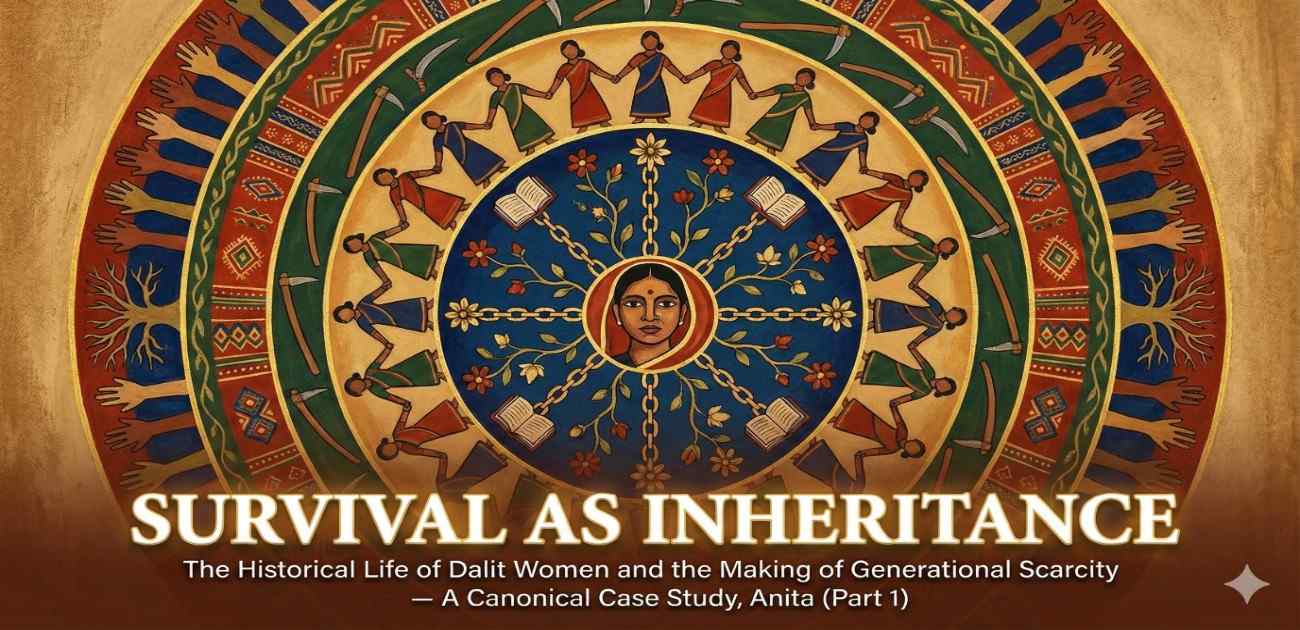
Intro Note: This is the first part of a two-part series exploring the life narrative of Anita (pseudonym), a Dalit Ambedkarite feminist activist. This section traces her childhood, schooling, and early encounters with caste, situating them within the Caste-Based Survival Trauma (CBST) framework.
Abstract
This article examines the life narrative of Anita (pseudonym), a Dalit Ambedkarite feminist activist. Based on Dr. Vaishali Sonavane’s PhD research, Lived Experiences and Cultural Renaissance: A Study of Dalit Women in Urban Employment in Maharashtra (in-depth interview recorded in 2014), it explores a Dalit woman whose life trajectory exemplifies historically produced survival regimes, relationally transmitted caste trauma, and gendered structural exclusion.
Using in-depth interviews and the Integrated Caste-Based Survival Trauma (CBST) Framework (Sonavane, 2025), this study situates her experiences across education, social movement participation, and family life. Anita’s narrative demonstrates how psychological harm, epistemic violence, and embodied discrimination accumulate over time, producing long-term cognitive, emotional, and somatic consequences. Her story serves as a canonical illustration of CBST principles, highlighting the intergenerational and temporal dimensions of caste-based trauma, the costs of survival, and the role of political-cultural resources in fostering resilience.
Family History and Social Background
Anita explains:
“…My great-grandfather was educated till the 4th class. After that time, his 4 sons and one daughter also got an education. Our Attya (aunt) was taking cases at court… We got thrust into education in heredity (Babasaheb); everyone from our house was in the field of education. …My father was never active in any religious activity as such; he used to say my children are my god. Mother was illiterate, and she used to take us to temples.”
When her grandparents shifted to Pune city, she recalls how they were forced to pretend they were Brahmins or had to hide their caste to sustain the better life they could lead:
“…It means there was caste discrimination; otherwise, they should not have asked to wear ‘Janevu/janava’. (Anita’s Mother added, “Yes, at that time in Pune city, there was caste-based discrimination; my father was very good looking, so he could look among them (Brahmins)).”
Psychological Analysis
Gabor Maté emphasizes that trauma is internalized relationally: “trauma is what happens inside you as a result of what happens to you” (Maté, 2018), highlighting the long-term impact of witnessing and navigating discrimination. Buswala (2023) shows how symbolic practices like caste concealment create chronic tacit surveillance, embedding anxiety and adaptive survival strategies. Handford (2020) adds that naming these inherited pressures as trauma externalizes systemic blame and lays the groundwork for resilience.
Childhood and Early Education
Anita shares:
“…If I look at childhood, I have completed my primary education as well as high school education, where almost 90% people are from the Buddhist community. Because of that, students studying here belong to the same caste. It means from the Bahujan Samaj. Prasthapits (dominant/established people) did not have any connections here, and teachers also were from the Bahujan Samaj. Even though there were some Brahmin teachers, there was no caste-based realization at the school level. On the other hand, the Brahmin teachers were very appreciative of me. I think this helped me progress. I used to come first in class, participate in ‘Vaktrutva’ competitions, etc. In these types of things, Brahmin teachers have supported me a lot.”
She continues:
“There used to be interschool competitions. Many times, we were going outside our school campus to participate in particular competitions, generally hosted were the Brahmin-dominated schools like Hujurpaga, Ahilya Devi, and Modern schools. We used to get an inferiority complex in front of them; their uniform was excellent. (Mother: Once at Lance Club, 6 schools participated in the ‘Vakrutva’ competition, and Anita participated from her school. Her speech was very good, but they did not give her a prize. Because there were participants from Nu.Ma.Vi. Modern, Ahiyladevi schools, which are Brahmin-dominant schools. They tried very hard to skip her name, which was a long-time struggle for them, but they were not able to neglect her totally, so finally they gave her the ‘Uttejanarth’ prize. After that, teachers came and asked her, ‘First time we saw you here, from which school you have come, and you did well.’) There is a huge difference in the style of talking, the language they use, complexion they have. Their uniform creates separation, and you look inferior here. Your caste and thus the school you belong to matter a lot. Sometimes we know that we are doing well, but we don’t get appreciation, and apart from that, we get discouragement most of the time. And that’s why abilities get suppressed.”
Psychological Analysis
Non-appreciation and enforced suppression fracture the effort–reward relationship, producing internalized inhibition of ambition (Sonavane, 2025). Maté (2018) emphasizes that chronic social exclusion affects emotional regulation and stress processing. Buswala (2023) highlights that micro-humiliations, such as uniforms, institutional prestige, and symbolic distancing, operate as tacit caste conditioning, influencing self-perception and anticipatory shame. Handford (2020) identifies these patterns as early trauma nodes where systematic non-recognition is psychologically injurious and requires narrative re-framing to mitigate long-term harm.
Caste Experiences and Realizations
Anita said:
“I started to realize my caste when I took part in various competitions like storytelling, speech delivery, etc., at college. During those 5 years, I never got the first number. At the most, I could get the ‘Uttejanarth’ prize.”
Anita further adds:
“My second experience, at the time of the Khairlanji massacre in 2006, I was in my second year of college. Every year, the college calls for papers for the yearly magazine. I used to write an article every year for the magazine. That year, my paper was “Surya Putranchi Kaifiyat”. (This was regarding the Khairlanji issue) That paper I submitted, paper was scrutinized, and I was called by our Marathi subject Madam in her cabin. She asked me to meet her. She was alone in the cabin, and she asked me to sit down. She said you have this paper for publication. I had given two papers at that time, one was this paper, and the other one was on the Reservation. So, she said to me, “Where is this all now? (Caste) There is nothing like this nowadays. Ok? She asked me, “What is your caste?” I said I am Buddhist. On that, she asked, Mhanje Maharach na? (It means Mahar only, right?) Look how it is, what Babasaheb Ambedkar did?” she said like this. At that time, I was confused. I thought, she is a professor, she teaches us, and she has got doctorate, then how can she say like this? (About Ambedkar)”
Psychological Analysis
These incidents exemplify epistemic trauma, where authority figures deny lived experience, producing confusion, mistrust, and destabilized self-concept (Fricker, 2007; Sonavane, 2025). Maté (2018) frames this as relational invalidation, showing how repeated undermining by influential others disrupts self-trust and emotional regulation. Buswala (2023) emphasizes that routine communicative practices, including denial of caste realities, symbolic dismissal, and performative unconcern, embed structural caste oppression into the psyche, making discrimination internalized and often invisible. Handford (2020) underscores the therapeutic value of naming such experiences as trauma, allowing externalization of systemic blame, reducing internalized self-blame, and supporting meaning-making.
Grades, Depression, and the Internalization of Failure
Anita recalls:
“At the time of pursuing an MA in political science, I had developed an inferiority complex in this department due to the discriminatory treatment of Dalits. That led me to face a year gap, and I sat at home. I had developed a feeling that I could not do anything in life.”
Psychological Analysis
Depression here is structural, not individual. Repeated lack of recognition collapses self-trust (Sonavane, 2025; van der Kolk, 2014). Maté emphasizes that chronic invalidation fosters learned helplessness and somatic stress (Maté, 2018). Buswala notes that ongoing low-intensity caste exclusions—being overlooked, subtly discouraged, or implicitly devalued—accumulate into affective burdens mirroring depressive symptoms (Buswala, 2023). Handford (2020) highlights naming such patterns as trauma externalizes harm and enables narrative reframing.
Educational Struggles
Anita recalls:
“…Till the graduation level, if I were able to get very good marks… But here these low grades have given me a very bad shock… I started thinking that, ‘I am not capable…’ While coming to study at Women’s Studies, I have realized why I was getting low grades… students who were basically coming from a Marathi background and from rural background, basically are Dalit-Bahujan community in the department; there was no single person who has ever highest in class from the Bahujan community. They most of the time deserved ‘B’ and ‘O’ grades. How could it be possible that not a single girl or boy is eligible to get the highest among Dalit-Bahujan community students?”
She adds:
“…If I had also done this pleasing business, I should not have faced this loss; I would have been getting good grades.”
She continues:
“Even in a university setup… Dalit and backward class people get discriminated against based on English. They have to suffer a lot due to this.”
Anita, with irritation, shares:
“Sometimes they say, ‘Oh! You do not look like Dalit. We thought that you were non-Dalit.’ And that is very irritating.”
Anita continues:
“Even though we do well, our accent, our fluency is compared to others; we are constantly reminded that ‘your English is not enough.’”
Psychological Analysis
Language functions as refined caste surveillance. Psychological injury here is chronic self-monitoring, anxiety, and anticipatory shame. Merit becomes conditional on linguistic assimilation rather than knowledge (Sonavane, 2025; van der Kolk, 2014). Maté (2018) emphasizes the somatic coding of social exclusion, where stress patterns affect the body. Buswala (2023) shows linguistic policing as a micro-strategy of caste domination, and Handford (2020) identifies explicit recognition and naming of linguistic trauma as essential for mitigating internalized harm.
Ritualized Expulsion Through Linguistic Marking and Moral Suspicion
Anita, with a heavy heart, shares:
“I was selected on my credentials — my versatile reading and my prizes in elocution competitions — but during practice, I realised that they did not want to adjust to me. I also started feeling isolated in the group, as they came to know that I belonged to the Mahar community.”
She continues:
“I used to go there after my lectures were over. There, for the first time in my life, I came to know about basic pronunciation faults (smile). They started heckling me on my pronunciation, which was considered imperfect in Marathi. Instead of calling me ‘ani-pani’, mocking me about my pronunciation of Marathi words, which I found very insulting and humiliating.”
She continues:
“The first shock I got was when I participated in the ‘Purushottam Karandak’ competition. I realized caste very harshly… Almost all the participants were Brahmins… I also started feeling isolated in the group, as they came to know that I belonged to the Mahar community. I realized that nothing was in common in the group for me, and it was due to my being a Dalit, and all others belonged to dominant castes. They started playing games, as they did not want me in their group.”
She continues:
“One day during Purushottam Karndak practice, it was announced, ‘At the time of our drama practice, someone’s money got stolen.’ … ‘Whoever has taken money should put it back. We will not say anything to that person; everyone will go inside one by one, and whoever has taken money will keep it there. After that full group sat together, and the director suddenly said that this meeting is called to find out once again who is suitable for this drama competition and who he thinks are not suitable and comfortable. He took all the names except mine. I was horribly shocked. I asked what about me? I have bunked my lectures to come here. He said, ‘No, you do not seem comfortable in my group, which means you are not suitable for my group. I was literally in tears. I was not able to say anything then; I just walked away from the place. I think that day money was not stolen at all! There were many questions in my mind: what to do? How could it happen to me? My condition was like an innocent child. I went directly to the bus stop. I was crying a lot. I was thinking about what it is. What was this experience exactly?” I was crying a lot. I was thinking what is it? But what was this experience exactly? I am able to understand it now. I should have replied back but I couldn’t.”
Psychological Insight
This episode exemplifies ritualized exclusion and embodied caste trauma. CBST highlights silent structural violence disrupting agency and producing confusion and somatic stress (Sonavane, 2025; Herman, 1992; van der Kolk, 2014). Maté identifies relational invalidation as core trauma, producing dissociation and hypervigilance (Maté, 2018). Buswala shows linguistic marking as a performative caste domination strategy, creating shame and exclusion (Buswala, 2023). Handford (2020) emphasizes naming the experience as trauma to reframe the narrative and prevent internalized blame.
Conclusion: Anita as a Canonical CBST Case
Anita’s life exemplifies the psychological architecture of caste-based survival trauma. Across schooling, family, higher education, and movement participation, she faced persistent exclusion, epistemic violence, and gendered discrimination, producing internalized inferiority, shame, and social anxiety. Her narrative demonstrates embodied and relational trauma, showing how caste operates through everyday interactions, institutional practices, and cultural narratives.
CBST (Sonavane, 2025) identifies trauma as cumulative, relational, and multi-generational, and Anita’s story illustrates these principles vividly: early school-based exclusion, ritualized humiliation in competitions, epistemic violence in classrooms, and patriarchal oversight within movements are all mechanisms producing long-term psychological harm.
Yet her narrative also shows resilience and political consciousness, with Ambedkarian frameworks and family support functioning as cognitive and emotional shields. Anita thus serves as a flagship case for the CBST framework, validating its central claims; trauma is structural, gendered, and intergenerational; survival strategies have a psychological cost; and recognition—both social and epistemic—is essential for healing and empowerment. Her story offers a model for research, policy, and scientific interventions aimed at addressing the deep psychological toll of caste and gender oppression.
Psychological Life, Survival, and the Making of Dalit Womanhood
Anita’s narrative, taken in its full length and texture, makes visible a psychological life that cannot be understood through individual pathology, resilience discourse, or abstract notions of empowerment. What emerges instead is a dense psychological ecology shaped by caste, language, gender, institutions, and historical memory. Her life does not merely illustrate oppression; it reveals how oppression is learned, embodied, interpreted, resisted, internalised, and sometimes survived without language.
From early childhood, Anita’s sense of self develops within a relatively protected Bahujan social ecology—schools, teachers, neighbourhoods, and family histories shaped by Ambedkarite consciousness. This early safety does not erase caste; it delays its psychic injury. When caste finally appears, it does so not as a sudden event but as a series of micro-dislocations; interschool competitions, uniforms, accents, pronunciation, language, and recognition. These moments teach the Dalit girl that merit is visible but not always legible, that excellence does not guarantee legitimacy, and that evaluation is never neutral.
Psychologically, this produces what can be described as anticipatory vigilance; a heightened awareness of when and where one will be diminished, ignored, or quietly displaced.
The “ani-pani” episode marks a critical psychological shift. Here, caste enters the body through the mouth, the tongue, sound, and laughter. This is not symbolic violence alone; it is somatic. Language becomes a site of humiliation, and speech—previously a source of confidence and achievement—turns into a vulnerability. Such moments fracture the continuity between effort and reward, a core psychological injury that later reappears in academic grading, classroom interactions, and institutional evaluation.
The repeated experience of being selected for merit and then slowly expelled through social cues creates a deep confusion- Was I chosen because I am capable, or tolerated until I become inconvenient?
The Purushottam Karandak episode reveals caste as an administrative and affective system rather than a single act of discrimination. There is no open accusation, only orchestration—silence, insinuation, staged suspicion, and final exclusion. Psychologically, this produces shock without closure. Anita is not given an explanation she can contest; she is given an outcome she must absorb. This form of injury often leads to self-questioning rather than resistance, especially when political language is not yet available. Her repeated return to innocence— “I was not politically aware,” “I was very innocent”—signals not naïveté, but the structural withholding of interpretive tools from Dalit women at the moment harm occurs.
Education, rather than functioning as a consistent ladder of mobility, becomes a terrain of psychological erosion. The sudden drop in grades after years of academic excellence produces a collapse of self-trust. Importantly, Anita does not initially read this as structural discrimination; she reads it as personal incapacity. This internal talk is harmful for the mind, body, and soul.
Stay tuned for – Part Two: Family, Movement, and Ambedkarite Lineages of Survival
This second slot turns to the domains where survival becomes politicised, gendered, and historically anchored. Slot 2 follows Anita’s life as it unfolds within family structures, Dalit movement spaces, and Ambedkarite political traditions, where dignity is not merely defended but actively reworked.
References
- Buswala, B. (2023). Undignified names: Caste, politics, and everyday humiliation in North India. Contemporary South Asia. available at https://www.tandfonline.com/doi/full/10.1080/09584935.2023.2262943#abstract
- Fricker, M. (2007). Epistemic injustice: Power and the ethics of knowing. Oxford University Press.
- Gillborn, D. (2008). Racism and education: Coincidence or conspiracy? Routledge.
- Handford, C. (2020). Naming the pain: A model and method for therapeutically assessing the psychological impact of racism. James Madison University.
- Herman, J. L. (1992). Trauma and recovery. Basic Books.
- Fogleman, C. D. (2024). The myth of normal: Trauma, illness, and healing in a toxic culture. Family Medicine, 56(1), 58–59.
- Maté, G., & Maté, D. (2022). The myth of normal: Trauma, illness, and healing in a toxic culture. Avery.
- Paik, S. (2014). Dalit Women’s Education in Modern India: Double Discrimination. Routledge.
- Sonavane, V. (2014). Lived experiences and cultural renaissance: A study of Dalit women in urban employment in Maharashtra (Doctoral dissertation).
- Sonavane, V. (2025). Integrated theoretical and methodological framework: Positioning caste-based survival within contemporary trauma theory. Available at: https://drvaishalisonavane.com/caste-based-survival-trauma-framework/
- Sonavane, V. (2025). Survival as inheritance: The historical life of Dalit women and the making of generational scarcity. Available at: https://drvaishalisonavane.com/survival-as-inheritance-dalit-women/
- van der Kolk, B. (2014). The body keeps the score. Penguin Books


Leave a Reply