
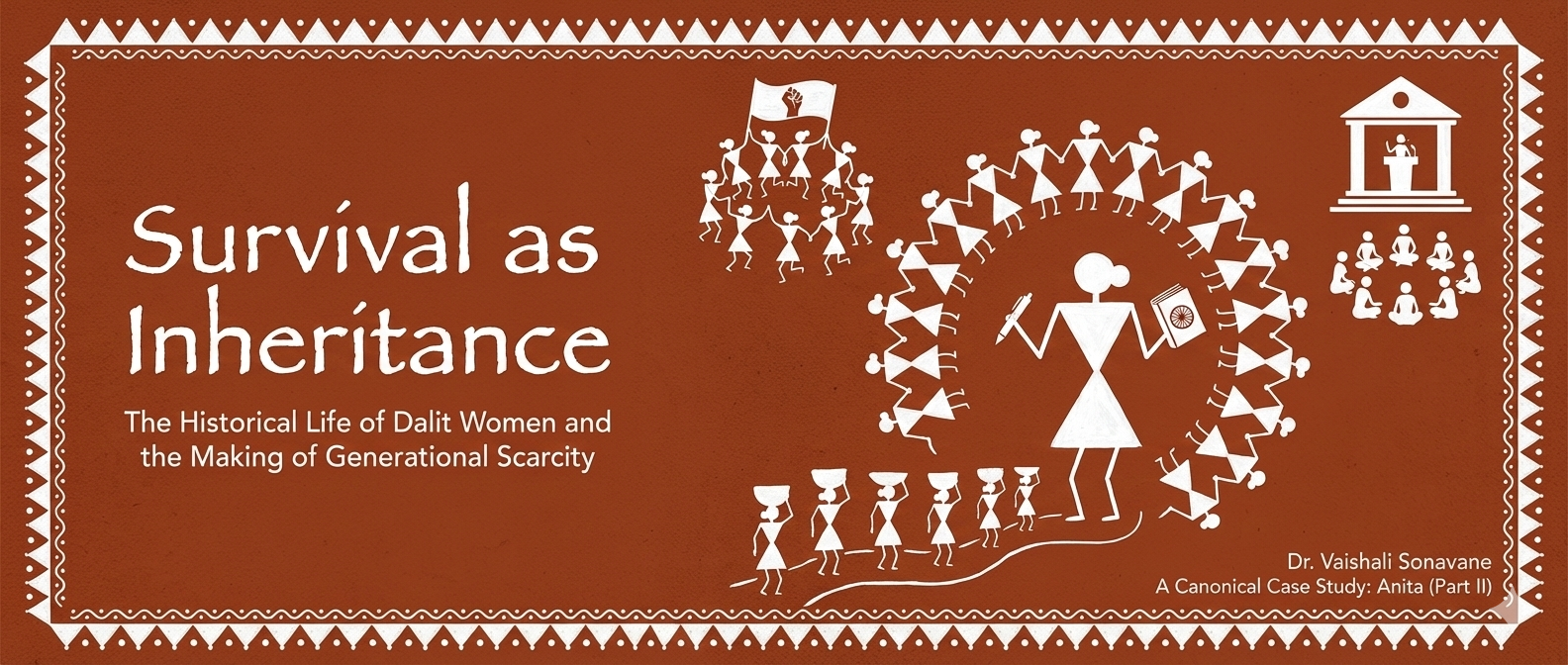
A Canonical Case Study: Anita (Part II)
By Dr. Vaishali Sonavane
Abstract
This two-part article examines the life narrative of Anita (pseudonym), a Dalit Ambedkarite feminist activist, as a canonical case of caste-based survival produced, transmitted, and negotiated across generations. Drawing on in-depth interviews recorded in 2014 as part of the author’s doctoral research— Lived Experiences and Cultural Renaissance: A Study of Dalit Women in Urban Employment in Maharashtra —and analysed through the Integrated Caste-Based Survival Trauma (CBST) framework (Sonavane, 2025), the study traces Anita’s experiences from childhood and early education (Part I) into adulthood across social movements, higher education, institutional workplaces, and family life (Part II).
Across both parts, Anita’s narrative demonstrates how caste and gender operate through epistemic invalidation, temporal denial, linguistic surveillance, moral policing, and institutional containment, producing cumulative psychological, relational, and embodied consequences. Survival for Dalit women emerges not as individual resilience or therapeutic recovery, but as a historically enforced condition sustained through intergenerational memory, political consciousness, and adaptive survival knowledge transmitted within families and communities.
Part II extends the analysis into adulthood, illustrating how caste-based trauma mutates rather than diminishes, reappearing within emancipatory movements, academic institutions, and professional spaces. By centring Anita’s verbatim testimony as primary epistemic data, the article advances a Dalit feminist methodological stance that treats lived experience as theory-generating, challenges neutrality as a mode of harm, and positions survival itself as a form of inherited political labour.
Keywords
Dalit feminist methodology; caste-based survival trauma; intergenerational memory; epistemic injustice; Ambedkarite politics; generational scarcity.
Methodological Orientation and Continuity
Part II continues the analytical architecture established in Part I. Anita’s narrative is treated as primary epistemic material rather than illustrative testimony. Long verbatim quotations are retained deliberately, in keeping with Dalit feminist oral history traditions that resist extractive summarisation and preserve testimonial sovereignty (Fricker, 2007). Interpretation follows the Integrated Caste-Based Survival Trauma (CBST) framework, which conceptualises trauma as cumulative, relational, intergenerational, and embedded within everyday institutional practices rather than as discrete or exceptional events (Sonavane, 2025).
Intergenerational Survival and the Inheritance of Aspiration
CBST insists that survival does not begin with the individual; it is inherited. Anita situates her life within a dense intergenerational history of struggle, education, and constraint—most powerfully articulated through her mother’s narrative. Education in her family was rare, fragile, and fiercely protected:
“In our whole village, our house was the only educated one, although we belonged to the Mahar community… My great-grandfather was educated till 4th class… my grandfather declared that he will see to it that all his children will get educated like Ambedkar.”
Survival, however, demanded tactical negotiation with caste violence:
“My father was very good looking… Brahmin friends used to give him janv , he used to put it and go with them to eat food… otherwise they would not have allowed him.”
CBST reads this not as anecdote but as caste camouflage—an inherited lesson that dignity must be negotiated rather than assumed. The mother’s unfulfilled intellectual aspirations resurface as transferred expectation:
“Writer in me got dead before taking birth… I am expecting all my expectations should be fulfilled by my daughter, whatever I did not do till now.”
Here, Anita inherits not only ambition but unfinished lives, a defining structure of generational scarcity under caste.
Gendered Containment of Aspiration: Becoming “Suitable”
Anita’s early aspiration was expansive:
“In childhood, I wanted to become a Doctor… later realised it would not be possible to pay the fee.”
Economic constraint intersects with caste, but gender rapidly narrows the horizon of possibility. Teaching is presented as the “ideal” occupation for women:
“Teacher means ideal job for women… fixed timings… she can look after housework properly… that’s why in the marriage bazaar also there is more preference for women teachers.”
CBST identifies this as respectability-as-survival , where limitation is reframed as prudence. Anita resists this narrowing:
“Many people don’t go for higher education once they get a job, and you get stuck in your small world, dreams become limited.”
A mentor’s intervention becomes pivotal:
“He came to my house and gave me the book Agnipankh … and I changed my decision.”
Education here functions not merely as mobility but as psychological rescue from gendered foreclosure.
Dalit Womanhood Within Movements: Equality as Language, Patriarchy as Practice
Anita’s adult political life unfolds within Ambedkarite and progressive movements that articulate equality while reproducing gendered hierarchies:
“Till now I have delivered 27 speeches as a youth speaker… But I feel that here being a Dalit is a different experience and being a woman is a different experience.”
She names the contradiction unambiguously:
“Basically, in movement, though there is language of equality and language of revolt… male–female discrimination exists permanently.”
CBST conceptualises this as procedural exclusion—participation without authority. At an Ambedkar Jayanti seminar where she was the only woman speaker:
“The first boy took almost one and a half hours… when my turn came host asked me to finish within 5 minutes… then urged me for 4 minutes.”
Her diagnosis is precise:
“Time was not the matter, but the matter was the different treatment for women. They thought, What great, this girl is going to speak?”
CBST identifies this as temporal silencing, reinforced through moral surveillance:
“The girls working in movement are considered characterless… people think these girls are here for love affairs.”
Respect becomes symbolic and hollow:
“They call us ‘Tai’. By calling ‘Tai’, did we get respect? No.”
The internal logic of caste patriarchy is condensed in her metaphor:
“They think, ‘I am Babasaheb, and you all are Ramabai.’”
Partially, women’s labour is naturalised as sacrifice; leadership is masculinised as inheritance.
Leadership, Disillusionment, and Demand for Change
Anita articulates generational disillusionment:
“We, the young people, get questions—where is the movement practically?”
She diagnoses the structural impasse:
“Only one leadership we have and that is Babasaheb Ambedkar… at a practical level, leadership is in the hands of males.”
Her demand is explicit and urgent:
“We demand women’s leadership now.”
CBST frames leadership denial as future foreclosure—without representation, survival reproduces itself as stagnation rather than transformation.
Academic Marginalisation, Language Politics, and Depression
Academic institutions reproduce caste through cumulative, everyday practices:
“There was no single Dalit–Bahujan student who ever got the highest grade.”
Language becomes a sorting mechanism:
“If I say the same answer in Marathi and another person says it in English, why difference in treatment?”
Faculty indifference converts into psychological harm:
“They are suffering because they have to teach Dalit–Bahujan students— potapanyasathi .”
The outcome is internalised erosion:
“I got into depression… I thought I was not capable.”
Trauma theory recognises this not as fragility but as an intelligible response to prolonged epistemic invalidation (Maté, 2018; van der Kolk, 2014).
Women’s Studies as Counter-Institutional Space: Holding Conflict Without Silence
Within Anita’s life history, the Women’s Studies Centre emerges as a rare institutional space that does not demand silence in exchange for inclusion. Unlike other academic and movement spaces where caste and gender tensions are denied or individualised, the Centre allows conflict to surface and be worked through collectively.
“As I work at the women’s study centre, women are more in number… if I had been somewhere else must have got very different experiences.”
What matters is not the absence of caste, but the presence of space:
“We have huge space to express ourselves… good discussion on caste-based day-to-day issues.”
Conflict is institutionally legitimised:
“They promote thinking that there should be fights; if you are not fighting, it means there is some problem.”
CBST reads this as a structural interruption of trauma logic—conflict becomes indicative rather than deviant.
Confronting Caste Violence and Institutional Accountability
Anita recounts a critical episode at the Women’s Studies Centre that illuminates how caste violence can surface even within progressive academic spaces—and how institutional response determines whether such violence accumulates as trauma or is interrupted through accountability. During a programme organised at the Centre, where the Ambedkarite activist was invited to speak, an informal discussion followed. As Anita recalls, one of her colleagues—who frequently expressed strong opinions—remarked:
“This activist (Name removed with purpose) is Gandhian.”
Anita responded by situating him differently:
“No, he is Ambedkarite.”
The exchange escalated abruptly. The colleague replied:
“Ambedkarite is shit!”
Shocked, Anita immediately challenged the statement:
“What shit? Being Ambedkarite means shit?”
The colleague reiterated the insult:
“Yes, being Ambedkarite means shit.” (gesture repeated)
Anita notes that both of them were under intense workload stress at the time, which may have contributed to the interaction becoming a confrontation rather than a reasoned discussion. However, she is clear that the insult itself constituted a direct assault on dignity rather than a difference of opinion. Refusing to internalise the harm, she initiated institutional accountability by formally reporting the incident:
“I sent an email to our HOD regarding the same matter and urged that he should not say this. Our dignity gets challenged due to these types of comments.”
For Anita, Ambedkar is not an abstract ideological reference but a living source of survival and political energy:
“Dr. Babasaheb Ambedkar is our energy source, and we think he should be respected. We will not be able to tolerate his insult.”
She emphasised that the Centre must remain a space where caste is discussed responsibly rather than erased or demeaned:
“He should have used the given space to talk about caste positively.”
In response, the Centre initiated a collective discussion rather than suppressing the incident. The meeting, Anita recalls, was reflective and critical, ultimately concluding that such language should not be used when speaking about caste. However, the discussion also revealed a deeper tension—fear among some colleagues that addressing caste itself might be risky. Anita directly rejected this logic:
“By stopping talking about caste are not going to help us. That silence is not what we want. If people keep things in mind and do not feel open to having healthy talk, then it will be a loss for the community.”
At the same time, she insisted on ethical responsibility in speech:
“Whatever statements you are going to make should be sensitive towards others. Dignity should not be challenged, and people should think before saying anything.”
What troubled Anita most was the response of neutrality adopted by several colleagues:
“At that time, some people chose to become neutral. It was bothering me—why did they choose to become neutral? Do they not find any connection to talk on the issue of saying that being Ambedkarite means shit?”
She situates this silence within a longer pattern, noting that caste-specific derogatory remarks had occurred earlier as well, often passing without serious engagement. The emotional impact deepened when, a few days later, the same colleague made another statement that Anita identifies as explicitly violent:
“All Dalit women should be asked to do prostitution.”
Although the colleague later denied the statement or attempted to justify it by citing other writers, the damage was already done. Anita describes the lingering effect:
“I was very disturbed for a long time because of that.”
When she demanded clarification, the colleague reframed the statement as a political critique, arguing that Dalit women activists who oppose dance bars and prostitution should themselves experience such work to “truly understand” the lives of bar dancers and sex workers. For Anita, this reasoning compounded the violence—it suggested that Dalit women must bodily suffer to earn political legitimacy. She notes that such remarks had circulated repeatedly as “loose talk” until the Centre intervened decisively. The collective discussion, while uncomfortable, ultimately halted further repetition of these statements.
Within the CBST framework, this episode demonstrates a crucial distinction: trauma was not mitigated through individual resilience or emotional endurance, but through institutional accountability. The Women’s Studies Centre functioned as a counter-institutional space where caste violence was named, confronted, and structurally interrupted—preventing its accumulation into long-term survival trauma.
Anita further reflects that even within a space committed to dialogue, conflict does not always follow predictable or conscious lines. At times, divisions emerge organically, revealing latent hierarchies and unresolved historical tensions within marginalised communities themselves. As she recounts:
“While discussing one issue group got automatically divided into two groups. It was not conscious, but it evolves in the process.”
The immediate context was a discussion on the creamy layer policy. A female colleague belonging to the DTNT community raised a question rooted in lived hardship:
“She shared that she had suffered a lot to get a non-creamy layer certificate. Her stand was why this is necessary for DTNT and why not for SC category?”
During the discussion, Sir attempted to explain the rationale behind the policy. Anita is careful to separate caste loyalty from analytic honesty:
“Actually, I think Sir was communicating properly; I am not supporting him just because he belongs to my caste, definitely it is not like that.”
However, the colleague perceived the explanation as humiliating and began to cry. Anita recalls that this moment altered the emotional register of the discussion:
“She found that talk humiliating… and started crying.”
The conversation shifted from policy to affect. Anita observed that the core question— why the creamy layer applies differently to different caste groups —became submerged beneath emotional interpretation. She reflects candidly:
“I thought crying there was unnecessary; her stand was why a creamy layer certificate is necessary for DTNT and why not for SC community.”
As the exchange intensified, a broader narrative began to crystallise—one that positioned Scheduled Castes as disproportionately heard and privileged:
“One part of the group was saying, only SC’s pain had been discussed a lot, and the experience they got because of untouchability gets heard. But OBCs and DTNT also had experiences of untouchability and have painful lives, which are not heard or addressed, constantly in isolation.”
Anita responds by introducing historical specificity rather than collapsing all forms of suffering into sameness:
“If we see there is pain for everyone, but untouchability is the thing which SC’s have suffered, not OBCs—that was the system of ‘Gavgada’.”
As positions hardened, group identities became increasingly visible:
“During the discussion, people from one caste or from SC became one side of the group, and the remaining were on the other side.”
Looking back, Anita names this moment as deeply unsettling:
“Actually, that was a very bad picture.”
What disturbed her further was how caste stereotypes re-emerged in the heat of discussion. She noticed that Dalit assertion—particularly from Mahar participants—was quickly reinterpreted as aggression:
“In the hot talk time… it created an opinion about the Mahar community that they are dominant and violent.”
She recalls how even minimal disagreement was reframed as insensitivity:
“We did not say anything much, but even though they labelled us as ‘dominant’, they asked us, ‘You should convey your point sensitively, look at her, she started crying.’”
Anita responds with sharp reflexivity:
“I was feeling like laughing. Our voice can be high, our voices are like that, our way of talking is like that.”
Yet this embodied mode of speech—historically shaped by resistance—was pathologised:
“Just because of that, they said us dominant and stated that the caste Mahar’s are aggressive.”
This stereotype remains unresolved for her:
“I have an objection to that till now.”
She situates this incident within broader intra-Dalit tensions, particularly narratives that circulate among marginalised groups themselves:
“Matang community will say, ‘Mahar’s have taken all benefits, they have become very dominant, they are misusing the Atrocity Act.’”
Anita does not deny the possibility of misuse, but she insists on structural analysis rather than moral panic:
“Some people may have misused the act, but we have to think what are the reasons behind creating an image of one caste as dominant? And being dominant means what?”
Within the CBST framework, this moment illustrates how structural scarcity and uneven recognition are redistributed as inter-group suspicion , turning survival politics inward. Yet Anita is equally clear that the presence of conflict does not negate the value of the space itself. She affirms the Women’s Studies Centre as a site that enables such difficult encounters to occur without erasure:
“As Dalit women working in a place like women’s studies, getting part of the environment which is progressive, trying very hard for the change and having space for healthy fights… this department is very supportive of Dalits and women.”
She articulates the core principle learned through this experience:
“Not only equality but equity with differences is very important.”
Silence, she insists, offers only a deceptive resolution:
“Whatever the differences are, keeping total silence on them will provide superficial equality, which is not useful at all.”
Through the pedagogical and ethical orientation shaped by Rege’s leadership, Anita arrives at a deeper understanding of equality:
“If she had said, ‘Don’t talk on caste, don’t share your surnames,’ then it would not have been real equality… something would have remained hidden. But the opposite environment made me conscious.”
CBST recognises this as conflict-holding capacity —an institutional condition where difference is neither denied nor punished, allowing historical pain to surface without being converted into silence or individual blame.
Caste, Education, and Institutionalised Emotional Entrapment
Anita’s account of Safai Karmachari employment under Warasa Hakka exposes bureaucratised caste containment:
“Educated and illiterate, both types of people are here to clean the toilets… that girl who did LLB is also in the same post… How is this going to stop then?”
Education does not enable exit; it sharpens awareness of stagnation. CBST conceptualises this as institutionalised caste inheritance producing aspiration fatigue and chronic psychological injury (Koileri, 2025).
Conclusion: Anita as a Canonical Adult Case of CBST
Anita’s life history demonstrates that caste-based survival trauma does not diminish with age or education; it mutates into procedural, bureaucratic, and gendered forms. Her narrative confirms CBST’s core propositions: trauma is cumulative and time-bound; recognition governs psychological survival; silence reproduces harm; survival itself carries cost.
Anita’s life does not merely illustrate theory—it disciplines it. Her narrative demands that mental health, feminist praxis, and policy abandon neutrality and centre caste, gender, time, and dignity as psychological variables. Without such reorientation, survival will continue to masquerade as normalcy.
References
- Fricker, M. (2007). Epistemic Injustice . Oxford University Press.
- Koileri, V. A. K. (2025). Healing the psyche from caste violence. International Journal of Indian Psychology , 13(2), 1385–1391.
- Maté, G. (2018). The Myth of Normal . Allen Lane.
- Rege, S. (2013). Against the Madness of Manu . Navayana.
- Sonavane, V. (2014). Lived experiences and cultural renaissance: A study of Dalit women in urban employment in Maharashtra. (Doctoral dissertation).
- Sonavane, V. (2025). Integrated theoretical and methodological framework: Positioning caste-based survival within contemporary trauma theory. Available at https://drvaishalisonavane.com/caste-based-survival-trauma-framework/
- Sonavane, V. (2025). Survival as inheritance: The historical life of Dalit women and the making of generational scarcity. Available at https://drvaishalisonavane.com/survival-as-inheritance-dalit-women/
- van der Kolk, B. (2014). The Body Keeps the Score . Penguin.
Leave a Reply