
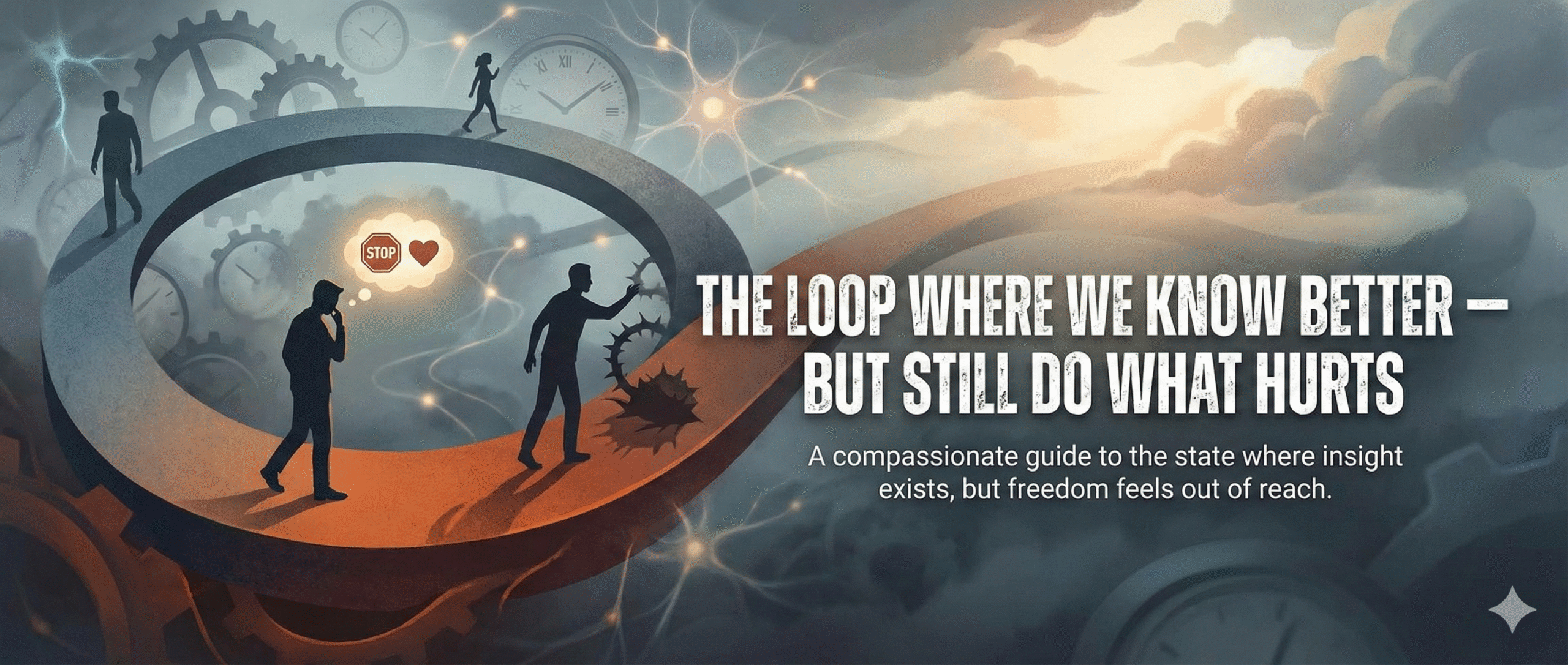
A compassionate guide to the state where insight exists, but freedom feels out of reach
There is a quiet, tender kind of suffering that many people struggle to put into words. This is not the pain of not knowing, but the ache of knowing clearly—and still finding yourself drawn back into the very things you hoped you had moved beyond.
I know what feels right. I know what I wish not to do. I know the kind of person I long to be. And yet, in certain moments, I feel myself shift into someone I hardly recognize.
I raised my voice when I had promised myself I wouldn’t. I act in ways I later wish I had not. I slip into cycles of negativity, complaint, and victimhood. I find myself fighting endlessly for justice until I am worn thin and heavy with bitterness.
Afterwards, I sit with crushing shame and confusion. “How did I become this again?”
One of my clients described this state in these exact words,
The Question (As It Is)
“Please explain to me the psychological state in which- you know what is wrong, and you end up doing that unwantedly, e.g., hitting the child, shouting, yelling. Thinking negatively and getting into the complaining and victim mode. defending and fighting for justice. you know and have experienced that your thought makes your life, and you have benefited from it a lot. though at a certain point you get into the trap and loop, as if you were never like that ever! you feel trapped, cheated, and manipulated by your own self.”
If this sounds like you, this article is for you.
1. First Reality Check: You Are Not a Bad Person
Let’s clear this first. If you are even asking this question, you are not careless, not unconscious, not heartless. You do know right from wrong. What is happening is this– Your thinking brain knows what is right.
But your survival brain takes over when you feel threatened, overwhelmed, humiliated, scared, or powerless. Under threat, the brain literally shifts control from the logical, reflective part to the alarm-and-action part (LeDoux, 1996; Siegel, 2012).
At that point, the part of the brain that helps you pause, think, choose, and stay kind goes offline. And the part that only knows to attack, to defend, to shout, to fight, to blame takes control.
That is why, later, you say, “I wasn’t myself.” You are not lying when you say that. Neurologically, you really weren’t.
2. Why It Feels Like All Your Growth Disappears in One Moment
The same client of mine mentioned something very painful and very precise (as it is) — “As if I were never like that ever!”
This is devastating to feel. It makes you believe all your work, healing, discipline, and awareness were fake. But the truth is this, you don’t lose your growth. You lose access to it when your nervous system feels unsafe.
Trauma research shows that different brain states hold access to different memories, skills, and identities — this is called state-dependent functioning (van der Kolk, 2014). When the body feels danger, disrespect, shame, or injustice, it does not care about the affirmations, therapy tools, spiritual principles, manifestation, or logic.
Rather, it only cares about survival. So, the calm, healed, aware version of you gets pushed into the background. And the old survival version jumps in front. That’s why it feels like a total takeover.
3. Why Anger, Victim Mode, and “Fighting for Justice” All Come Together
On the outside, these may look like different problems—shouting, constant negative thinking, feeling like a victim, always arguing, defending, and protesting. But inside the body, they are actually the same response: the “fight mode.”
This response tends to show up when you feel powerless, unfairly treated, disrespected, trapped, or unseen. Some people fight by shouting. Some fight by arguing. Some fight by complaining. Others fight by turning the attack inward.
Even victim mode is a survival position, not a character flaw. Trauma psychology understands this as an adaptation to helplessness, not a pathology (Herman, 1992). The nervous system does not choose what is “healthy”; it chooses what once worked.
4. The Exact Loop Most People Are Stuck In
This is the cycle most people live again and again:
- Good Phase: “I’m better now. I understand myself. I won’t do this again.”
- Trigger Hits: Disrespect. Stress. Fatigue. Injustice. Fear.
- Explosion / Collapse: Shouting. Hitting. Fighting. Complaining. Emotional flooding.
- Aftermath: Guilt. Shame. Self-hatred. Crying. Regret.
- Promise Phase: “Never again.”
Then the cycle quietly reloads. This is known in trauma psychology as ‘repetition compulsion’— the nervous system replaying old danger patterns even when the present moment is different (van der Kolk, 2014).
This is not because you don’t mean your promises. It’s because promises cannot control a nervous system in survival mode.
5. Unpacking the Experience of Feeling “Trapped, Cheated, and Manipulated by My Own Self”
(as it is from the question of my client)
This realization can feel very tender, because the struggle no longer seems to exist only outside—it begins to feel like it is happening within. You may find yourself thinking, “I can’t trust myself,” or “My own mind feels like it betrays me,” or even, “Even when I know better, I still lose.”
Over time, this can give rise to quiet feelings of shame, self-doubt, hopelessness, and deep tiredness. But here is a truth that is rarely shared with enough kindness, you are not being manipulated by yourself.
What you are experiencing is the influence of an old survival system that once worked hard to protect you. Trauma theory helps us understand that many harmful adult behaviors are, in fact, childhood survival strategies that never had the chance to update (Herman, 1992).
This does not make the behavior okay or acceptable—but it does make it understandable, and worthy of compassion rather than condemnation.
6. The Most Important Hope in This Entire Process
This is the turning point; the fact that you can see this loop means you are no longer fully trapped inside it. Completely stuck people never ask, “Why am I doing this?” “Why do I lose myself?” “How can I stop?”
They just react.
Your question itself shows something deeply meaningful; a part of you is awake, aware, watching, and trying to understand. Many people never even get to this place; they remain unaware of their own wounds and keep repeating the same patterns without knowing why.
Healing often begins when we gently allow ourselves to see and acknowledge our pain, and that first step—though tender and difficult—is incredibly important. This ability to observe yourself is linked to integration between the emotional brain and the thinking brain (Siegel, 2012).
You may fall into the loop. But you are no longer blind inside it. You are standing on its edge.
7. What Actually Helps (And What Doesn’t)
Let’s be very honest. This loop does not break with more self-criticism, more motivational quotes, more positive thinking, more spiritual shame, more willpower.
Research shows the nervous system heals when one feels safe, safe relationships, body-based regulation, consistent repair, compassion, not punishment (Porges, 2011; Siegel, 2012).
The real question is not, “Why am I like this?” The real question is, “What made my body feel so unsafe that it had to explode like this?”
8. If You Are Reading This with a Heavy Heart
If you see yourself in these words, please hear this clearly–you are not evil. You are not broken. You are not hopeless. You are not fake.
You are a human being whose awareness has begun, but whose nervous system is still learning safety. And safety does not grow through punishment. It grows through gentleness, understanding, repair, support, and time.
If This Article Found You
If you felt exposed while reading this — not attacked, but seen — then something important is already happening. You are not at the center of the loop anymore. You are at the edge.
And the edge is where change quietly begins.
References:
- Herman, J. L. (1992). Trauma and recovery: The aftermath of violence—from domestic abuse to political terror. [cite_start]Basic Books. [cite: 82]
- LeDoux, J. (1996). The emotional brain: The mysterious underpinnings of emotional life. [cite_start]Simon & Schuster. [cite: 83]
- Porges, S. W. (2011). The polyvagal theory: Neurophysiological foundations of emotions, attachment, communication, and self-regulation. [cite_start]W. W. Norton & Company. [cite: 84, 85]
- Siegel, D. J. (2012). The developing mind: How relationships and the brain interact to shape who we are (2nd ed.). [cite_start]Guilford Press. [cite: 86, 87]
- Van der Kolk, B. A. (2014). The body keeps the score: Brain, mind, and body in the healing of trauma. [cite_start]Viking. [cite: 88, 89]

Leave a Reply