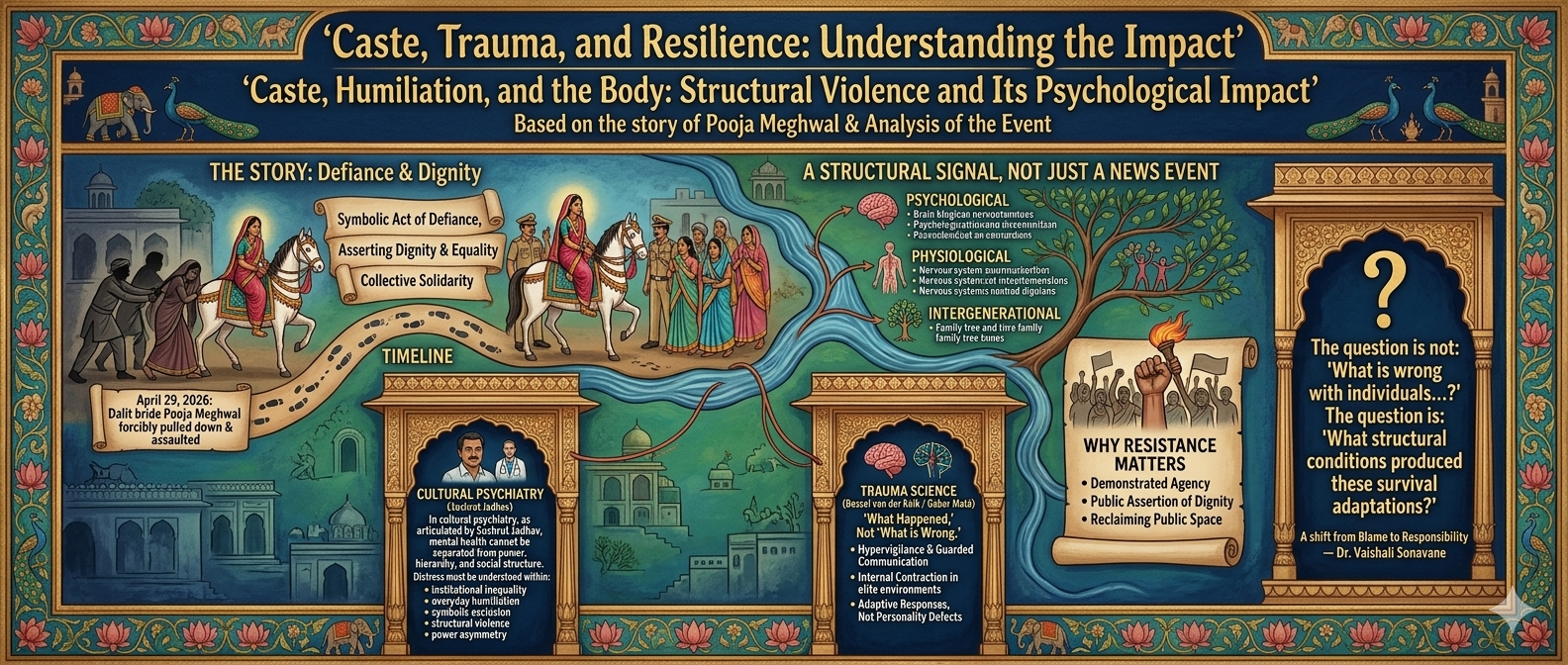
On April 29, 2026, in Udaipur, Dalit bride Pooja Meghwal was forcibly pulled down from a horse during her wedding procession and assaulted. Days later, she returned and rode again in a symbolic act of defiance, asserting dignity and equality in public spaces.
This event is not an isolated conflict between individuals. It is a structural signal. It reflects how caste hierarchy continues to regulate public life, particularly during life-cycle rituals that symbolise status and belonging.
When caste boundaries are enforced publicly, the impact extends beyond the immediate moment. It shapes psychological safety, physiological stress responses, and intergenerational patterns of adaptation.
Structural Interpretation Is Necessary
From the perspective of cultural psychiatry, as articulated by Sushrut Jadhav, mental health cannot be separated from power, hierarchy, and institutional inequality. Distress must be understood within the social structures that produce it. Psychological responses cannot be interpreted in isolation from structural positioning.
In contexts structured by birth-based caste hierarchy and graded notions of ritual purity and social ranking, dignity, credibility, and mobility are socially regulated. Caste-based incidents are therefore not interpersonal misunderstandings. They are expressions of a system that maintains hierarchy through layered mechanisms of inclusion and exclusion.
This event reflects how caste boundaries are maintained not only through norms but also through public enforcement. Ritual spaces become sites where birth-based ranking is asserted. Visibility is regulated. Participation becomes conditional. Dignity is positioned within a hierarchy.
In this case, enforcement was not symbolic alone. It involved physical force — pulling the bride down from the horse and assaulting her. This demonstrates that caste hierarchy can operate through tools of coercion and violence when its boundaries are challenged. Such violence is not accidental to the system; it functions as a mechanism that sustains graded social ranking by signalling who may cross boundaries and who must remain within assigned limits.
When violence is used to preserve ritual hierarchy, it is structural enforcement, not merely interpersonal aggression.
Trauma Science and Embodied Impact
Research by Bessel van der Kolk shows that repeated stress and humiliation become embodied memory. The nervous system encodes patterns of threat through physiological pathways, especially when experiences are repeated or identity-linked.
Similarly, Gabor Maté reframes behaviour through adaptation, emphasizing that survival responses develop in response to environmental conditions rather than personal deficiency.
When identity repeatedly carries social risk — humiliation, exclusion, diminished credibility, or punishment — the nervous system learns to anticipate hierarchy. Over time, this anticipation can shape vigilance in public spaces, guarded communication in caste-ranked contexts, stress activation around authority, internal contraction when visibility increases, and heightened alertness in situations resembling past power imbalances.
These are not personality traits. They are adaptive physiological responses to structured inequality.
Structural Trauma, Not Individual Weakness
Caste is not only discrimination in isolated incidents. It is a long-standing system of graded hierarchy that influences dignity, access, institutional recognition, and public mobility.
When hierarchy structures everyday life, it produces chronic stress conditions that can affect trust formation, leadership confidence, economic stability, relational safety, and intergenerational well-being. Repeated exposure to humiliation or enforcement reinforces stress regulation patterns in the body.
This is structural trauma. It is not individual fragility.
Resistance and Structural Change
The return of Pooja Meghwal to ride again, under protection, demonstrates that hierarchy can be challenged. Structural systems are maintained through power, but they can also be contested through collective action, legal protection, and public assertion of dignity.
Equality requires enforcement. Dignity requires protection. Structural hierarchy cannot be addressed solely at the psychological level; it must be addressed at the level where it operates — in public rituals, institutions, and social enforcement mechanisms.
Why This Belongs in Professional Discourse
If we are serious about diversity, equity, governance, leadership, institutional reform, and mental health frameworks, caste must be understood as a lived stress architecture embedded in social structure.
Trauma-informed analysis reveals the pathway clearly; social structure shapes physiological response, which shapes behavioural adaptation, which influences long-term outcomes. Without structural reform, we only treat symptoms.
The question is not why individuals react strongly in caste-charged situations. Human nervous systems respond to their environments. The more accurate question is what structural conditions produced these adaptations in the first place.
When we ask that question, responsibility shifts from individuals to systems.
And structural systems must change.
-Article by Dr Vaishali Sonavane